
After supper
DRAGOONED: Writing, talking, and rewriting like Herman Melville in "Scenes Beyond the Western Border" (1851-1853). Number 7.


“Aye, aye,” he shouted with a terrific, loud, animal sob, like that of a heart-stricken moose.
— Moby-Dick; or, The Whale Chapter 36, The Quarter-Deck
—the king of Hapzaboro; portly, pleasant; a lover of wild boar’s meat; a frequent quaffer from the can; in his better moods, much fancying solid comfort.
— Mardi: and A Voyage Thither, Chiefly of King Bello
TWO prairie dialogues between the narrating “Captain of U. S. Dragoons” and his Imaginary Friend (I. F. for short) enliven the January 1852 installment of Scenes Beyond the Western Border. Each dialogue, as originally published in the Southern Literary Messenger, had a unique descriptive label provided in the synopsis of contents on the front cover of the magazine. Neither label made it into the 1857 book version. The second dialogue, largely devoted to criticism of bestselling English novelist G.P.R. James and his perceived slander of “Americanism” in the False Heir, bore the curiously worded title, “Literature on the Little Arkansas.” For my reading of that conversation, identifying correspondences to the substance and style of Melville’s great 1850 manifesto of literary nationalism, “Hawthorne and His Mosses,” please check out
Here I want to focus on the first dialogue. Before revision, it boasted the unique designation, “After Supper.” This friendly but frequently contentious talk comes after a thrilling elk hunt, climaxing with an intensely romantic passage on the suffering and death of the “magnificent animal” chased and killed by the Captain-narrator. Present-tense verb forms, strategically deployed throughout, dramatically heighten the excitement of the chase, and the extreme pathos of the death scene.
Including the death-scene that immediately precedes the dialogue, this two-part segment in the magazine version was teased on the front cover as “A painful scene: After supper.” Lost in revision, like “Literature on the Little Arkansas.” The book version gives differently phrased synopses of the very same material:
Chapter V.
Return March—Splendid Elk Chase—Dialogue and Soliloquy—Buffalo Chase—Criticism of J. P. R. James—Prairie on Fire—Snow Storm—Fort Leavenworth, … 272
Neither of the two descriptive phrases, “painful scene” or “After supper,” appears in the Table of Contents for Scenes and Adventures in the Army: or, Romance of Military Life (Philadelphia: Lindsay & Blakiston, 1857 and 1859) where the matter of this sequence is now represented, after revision, as a “Splendid Elk Chase” and the “Dialogue” half of “Dialogue and Soliloquy.”1 Within the main body of text, however, the phrase After supper introduces the first dialogue in both printings—italicized in the 1852 magazine version, given without italics when reprinted in Part II, Chapter V of the 1857 book (reissued in 1859 with only the title page altered).2
Moreover, as printed on the cover of the Southern Literary Messenger, punctuation connected “A painful scene” to “After Supper.” Together, joined by a colon, these terms originally formed one caption. Fully understanding the dialogue requires knowing what came before, especially the passage once tagged as “A painful scene.” Below I give the brief but nonetheless meaningful scene that occurs just before the dialogue “After supper.” Here and throughout, emphasis in bold is mine.
Now, my fierce excitement subsides. I observe curiously—almost timidly—a magnificent animal, large as my horse, but of a loftier crest. Ah! what beauty, and what suffering! With majesty in all his bearing, he violently grits his teeth in pain or defiance; but in his beautiful eyes I imagine that rage is yielding to a mournful reproach.
And now I suffer a reaction. We are alone with Death, which my hand has summoned to this peaceful solitude. The still erect but dying animal faces me at six feet and painfully heaves. I stare dreamily into those fascinating eyes: his dignity of suffering seems to demand of me an explanation, or, a conclusion to the fatal scene.
At length, with a sigh, I finish my work; and with another ball end his pains forever!
For a short burst of pathos it’s a lot of writing like Melville. The eye-to-eye confrontation with “a magnificent animal” like a fine horse only taller and more majestic recalls the late chapter in Mardi where Melville’s travelling philosopher Babbalanja stares deep into the “soft, pathetic, woman eye” of a large moose, and directly addresses the “mighty brute” as “thou woodland majesty.”3
The royal “dignity” of the hunted elk, “magnificent” in appearance with so lofty a crest resembles that of the “White Steed of the Prairies” immortalized in Moby-Dick Chapter 42, The Whiteness of the Whale:
“a magnificent milk-white charger, large-eyed, small-headed, bluff-chested, and with the dignity of a thousand monarchs in his lofty, overscorning carriage.”
Wounded by the hunter, the elk “violently grits his teeth in pain or defiance.” The conduct of the cornered elk verbally rehearses the reaction of Ahab in confrontation with Stubb, as depicted in Moby-Dick Chapter 29, Enter Ahab; to Him, Stubb:
“Avast!” gritted Ahab between his set teeth, and violently moving away, as if to avoid some passionate temptation.
As a permanently maimed victim of assault, Ahab appears most vulnerable and pitiable when represented as a wild animal, grievously hurt in Chapter 36, The Quarter-Deck. For maximum pathos, Melville drops in a simile that compares the audible suffering of Ahab to the bellowing of “a heart-stricken moose”:
“Aye, aye,” he shouted with a terrific, loud, animal sob, like that of a heart-stricken moose; “Aye, aye! it was that accursed white whale that razeed me; made a poor pegging lubber of me for ever and a day!”
In “Scenes Beyond the Western Border” the stricken elk’s “dignity of suffering” recasts the passion of “moody stricken Ahab,” standing “with a crucifixion in his face; in all the nameless regal overbearing dignity of some mighty woe” in Moby-Dick Chapter 28 Ahab.
In another reformulation of language and thought from Moby-Dick, the look of “mournful reproach” imaginatively attributed to the dying elk calls to mind the exchange of looks pathetically rendered by Ishmael in Chapter 65, The Whale as a Dish:
… a young buck with an intelligent looking calf’s head before him, is somehow one of the saddest sights you can see. The head looks a sort of reproachfully at him, with an “Et tu Brute!” expression.
Fascinated by the eyes of the elk, the Captain-narrator dares to “stare dreamily” back. Melville’s hard-luck revolutionary Israel Potter, cutting grass for the King at Kew Gardens, likewise would find himself “staring dreamily about him,” looking “like some amazed runaway steer, or trespassing Pequod Indian.” The spell of the elk’s “fascinating eyes” on the narrator also recalls the effect of Ahab’s conjuring trick on the crew in Moby-Dick Chapter 124 The Needle: “with fascinated eyes they awaited whatever magic might follow.”
More parallels of vocabulary in Melville’s known writings are inventoried below.
WHAT BEAUTY
…the passion flower / What beauty in that sad conceit!
— Clarel: A Poem and Pilgrimage in the Holy Land (New York: G. P. Putnam & Company, 1876) Volume 2 Part 4 Canto 15, Symphonies
IN ALL HIS
But Ahab, my Captain, still moves before me in all his Nantucket grimness and shagginess. Moby-Dick Chapter 33 The Specksynder
serene and harmless in all his ways. Bartleby, The Scrivener
YIELDING TO A
This trigram occurs 3x in Melville’s writings, all in Pierre; or, The Ambiguities:
Isabel, who though once yielding to a momentary burst of aggressive enthusiasm, yet in her more wonted mood of mournfulness and sweetness, evinced no such lawless wandering.
Yielding to a sudden ungovernable impulse, Pierre darted his hand among the flames.
Yielding to a sudden impulse, he mounted the single step toward the door, and rang the bell.
THIS PEACEFUL
Occurs 1x in Melville’s writings, only in Moby-Dick Chapter 103 Measurement of the Whale’s Skeleton:
by merely poring over his dead attenuated skeleton, stretched in this peaceful wood
WITH A SIGH
ABRAZZA (with a sigh).—Alas, the poor devil! Mardi Volume 2 Chapter 76, Some Pleasant, Shady Talk in the Groves
with a sigh, I softly sing, “Carry me back to old Virginny!” The Paradise of Bachelors
“Entire stranger!” with a sigh. “Ah, who would be a stranger? — The Confidence-Man: His Masquerade Chapter 8, A Charitable Lady
“Ah,” with a sigh, “I shall make a poor lawyer, I fear. — Confidence-Man Chapter 43, Very Charming
The dialogue that follows this “painful” and emotionally wrenching “scene” remains invested in content about hunting and killing the elk—mostly, however, as the subject of commentary, philosophizing, and humorous debate. Of primary interest, again, is the writer writing. Melville’s trademark! As pointed out long ago by Edgar A. Dryden, “all of Melville’s narrators are, in some way, portraits of the artist at work.”4 “I.F.” the narrator’s Imaginary Friend continues to serve as chief critic of the narrative-in-progress. The importance of this role has been obvious since the attempted censure of the narrator’s “double-refined poetry and romance” in the previous installment. Here it’s out in the open, once the Captain-narrator addresses his invented travelling companion directly as “Dear critic and lover of bathos.”
Bathos, as here constructed, is opposed to pathos, “that which excites emotions and passions,” usually “tender emotions” according to Webster’s 1852 American Dictionary of the English Language. Per the same edition, bathos means “a ludicrous descent from the elevated to the mean, in writing or speech.” Pathos and bathos well describe the main literary effects of the two-part segment, originally titled “A painful scene: After supper.” The high sentimental mood of “A painful scene” almost vanishes in the “After supper” portion, where the rhetoric descends from the passionate expressions of sadness and awe we saw in “A painful scene” to the lowdown joy of cooking and eating elk-steak.
Unexpectedly, however, the passionate style of expression revives in the friend-critic’s enthusiasm for the partaking of simple “creature comforts” like good food and drink, and a “soothing pipe,” in the shelter of a lovely natural retreat. Text below is based on the magazine version in the January 1852 issue of the Southern Literary Messenger at page 48.
After supper. — The Hunter in the mouth of his tent reclines, with a pipe, upon a glossy bearskin; — before him, a desert expanse of grass and river; — his attention is apparently divided between the moon, suspended over the western hills; the flickering blaze of a small fire, and the curling smoke which he deliberately exhales. His friend stirs a toddy, reading with difficulty a crabbed manuscript. Loquitur. “When I saw you yesterday, beside your usual duties, acting as guide, surgeon — (for you have effectually cured the snake-bitten horse) — as hunter, or as butcher” —
“Say commissary !”
“I conceived hopes of you, that the poetic spirit was layed ; and when at supper to-night you ate so heartily of the elk-steak, I little thought you had been indulging again in such pathetic” —
“Pshaw ! it serves for a gilding to Life’s bitter pill !5 The delicious supper should have mended your humour: for I stake my reputation on it — as ‘guide, surgeon and hunter’ ” —
Imaginary Friend.6 “And butcher” —
— “ That the flesh, cooked, as it was, with a little pork, cannot be distinguished from that of the fattest buffalo cow that ever surrendered tongue and marrow-bones to hungry hunter.”
I. F. “Bravo! I have hopes of you! Kill your meat with a good conscience, and daily labour and excitement over, solid indeed is the hunter’s comfort! With grass and bear-skin bed, his toddy, and his soothing pipe — the musical ripple of the river sparkling in the moonbeams — I mean “ —
“Fairly caught! I little thought when I heard you abuse my pathos over the noble beast that had yielded his life to my sport, that mere creature comforts would thus inspire you! Dear critic, and lover of bathos! hast thou found poetry in a full stomach?”
I. F. “The devil’s in the moon. — And there goes another wolf ‘concert’ ” —
“With the thorough bass of a thousand bulls.”
I. F. — “All as thoroughly musical as the donkey braying in the caravan camps. I wish you a very good evening, ‘and a little better taste.’ ”
As Roy Buchanan would have put it, if you’re looking for trouble in the form of more writing like Melville, you’ve come to the right place. The phrase After supper occurs one time in Melville’s published writings, only in Moby-Dick Chapter 10, A Bosom Friend when, “After supper,” Ishmael and his new best friend Queequeg enjoy “another social chat and smoke.” In Chapter 97, The Lamp Melville neatly anticipated the dramatic situation of the “After supper” dialogue, in a simile describing how whalemen hunt and kill whales for oil they use in their own lamps, “even as the traveller on the prairie hunts up his own supper of game.” Allusion in the prairie dialogue to the Captain’s relish for “elk-steak,” supplied by the same “magnificent animal” he had hunted and killed only hours before, calls up Mr. Stubb, the second mate of the Pequod who dines at midnight on “whale-steak” in Chapter 64, Stubb’s Supper, cut from the “gigantic Sperm Whale” he had hunted and killed in Chapter 61, Stubb Kills a Whale.7
Hearty suppers happen many times in Melville’s writings. His third book Mardi: and A Voyage Thither has a whole chapter titled “THEY SUP.”
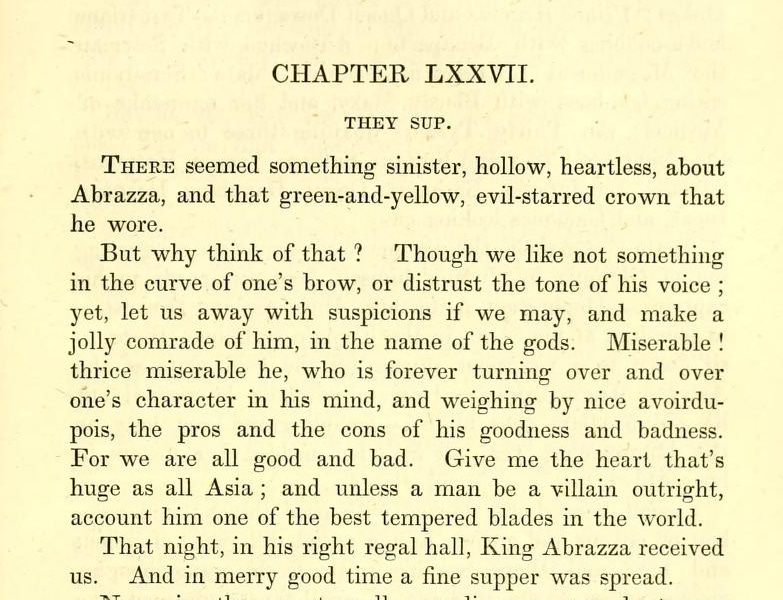
Again in Redburn: His First Voyage Melville reserves a whole chapter for supper, this time the bountiful “Supper at the Sign of the Baltimore Clipper” awaiting young Wellingborough Redburn in Liverpool.
“Two Sides to a Tortoise,” the second sketch in Melville’s 1854 magazines series “The Encantadas, or Enchanted Isles,” ends with a very Melvillean instance of bathos, in the descent from a dream vision of the cosmic World Turtle upholding the universe, to a hearty supper of “tortoise steaks and tortoise stews.”8 Change the word tortoise to elk and William B. Dillingham’s observation of the dramatic mood swing in Sketch Two of the Encantadas nails the rhetorical downshift from the pathos of “a painful scene” to the increasingly ludicrous discussion “After supper” in “Scenes Beyond the Western Border”:
“The
tortoiseelk had inspired in him serious thoughts disturbing in their cosmic implications. From this profound mood he abruptly changes and merrily eats the very creature that provoked such thoughts.”9
Although supper is supposed to have already happened in the prairie dialogue, remarks on the manner of cooking (“with a little pork”) and eating (“so heartily”) of the elk-steak add significantly to the discussion. Before either speaker can talk at all, about anything, their conversation requires a set-up in the way of a play. The set-up unveils a new voice, that of a theater director or stage-manager. Fairly elaborate stage directions introduce the dialogue, starting with the italicized phrase, After supper. The time is evening; the place is “the mouth of a tent,” close to a flickering campfire, with a sweeping vista of prairie grass, river, and “the moon, suspended over the western hills.” The scene evokes the ideal of a cozy bachelor retreat that recurs in Herman Melville’s writings. Prime examples include the Ti in Typee, numerous shady groves in Mardi, and the snug London apartment at “Elm Court, Temple” where the narrator is fortunate to dine by special invitation in the “Paradise of Bachelors.”
Besides giving the time and place of the dramatic action to follow, the director of this after-supper theater dialogue pointedly refers to the narrating Captain of U. S. Dragoons in the third person, and in a new light, as “the Hunter.” This new honorific tacitly acknowledges the passion for hunting as a sport, revealed earlier in the “Elk-shooting” segment. Verbally and conceptually, the role of “hunter” grants the Captain-narrator the status of Ahab and crew in Moby-Dick as hunters of whales. Forms of hunter (not counting four references to the eminent Scottish surgeon and naturalist, John Hunter) occur 44 times in Moby-Dick. Tashtego the Indian whale-hunter is said to be descended from moose-hunters,
“those proud warrior hunters, who, in quest of the great New England moose, had scoured, bow in hand, the aboriginal forests,” following “the trail of the wild beasts of the woodland.”
Before speaking, the Captain-narrator’s fictional “friend” is seen reading about the chase and death-scene of the elk from “a crabbed manuscript,” ostensibly the barely legible prairie journal from which these semi-fictional “Scenes Beyond the Western Border” derive. As here premised, however illogically, the imaginary companion personally witnessed the actual events as they happened, and now reads what the Captain-narrator made of them in his journal. In style and content, this journal account is supposed to be identical with the printed text we have been reading in the January 1852 issue of the Southern Literary Messenger. When I.F. speaks he immediately begins to criticize what amounts to the narrative-in-progress. Real readers are thus entertained with a critical response in something like real time, courtesy of the narrator’s confessedly imaginary friend.
Allusion to the Captain’s performance of new duties as guide, surgeon, “and hunter, or as butcher,” allegedly witnessed by I. F., may best be appreciated as a skillfully managed compression of stray details in the real Journal of the Santa Fe Trail by Philip St. George Cooke. One of the referenced actions, successful treatment of a “snake-bitten horse” that made the Captain a “surgeon,” in fact happened on the more eventful summer march, not the abortive fall expedition being described.
July 10…. Just as I arrived on the Camp ground this evening a rattle snake struck a valuable led horse of mine in the rim of the nostril; I immediately scarified it deeply with my penknife, and had it copiously washed until—fifteen minutes after—the hospital wagon arrived, and I procured some ammonia, which I applied until the skin came off (which it soon did). After swelling for twenty minutes, it is getting well.10
The role of “guide” specifically references the activity of October 5th as logged in Cooke’s official report:
In order to encamp every night in a river bottom where it was best, and where some drift wood could be obtained, I left the road near Jackson Grove, and guided my command three days and a half, and finally struck the road again at the point I wished, and within a mile of the distance I expected; although in places ten or twelve miles from the road, I had not lost a mile in the distance.
The real Philip St. George Cooke never mentioned hunting, killing, or eating elk anywhere his 1843 Journal of the Santa Fe Trail. During the summer march, one elk and one antelope were sighted on June 8th; and in July Cooke listed “elk” with the hare, badger, fox, and tarantula, as creatures formerly abundant on the prairie but now rarely encountered, if ever. On the fall trip, as described by Captain Cooke in 1843, only buffalo were chased and killed by dragoon officers.
The role of “hunter” ascribed to the narrating Captain of U. S. Dragoons in '“Scenes Beyond the Western Border” may have been inspired by this commendation of a multi-talented sergeant in Cooke’s official report of the fall expedition:
But one public horse was run after buffalo: this one I had led for the purpose, and on it, with what were killed by officers on their own horses, Sergt. C. L. McLane supplied the command with meat for about two weeks: (besides performing in a very efficient manner the duties of a wagon master.)11
Wagon master C. L. McLane hunted buffalo on a government horse kept fresh for the chase. This valuable service as hunter, furnishing “the command” with meat for at least a fortnight, was performed “besides” the sergeant’s normal “duties.” Cooke’s 1843 army report thus provided a basic outline for the job description that I. F. compiles when specifying extra duties done by the Captain-narrator in the “After supper” dialogue from “Scenes Beyond the Western Border." Presumably, the historical wagon master would have done or superintended the butchering of animals he himself had hunted and killed. If Sergeant McLane liked the title “Commissary” better than “Butcher,” his preference is not indicated in the official record.
“Say Commissary!” Commissary absolutely is the job title preferred in “Scenes Beyond the Western Border” by the Captain-narrator, who balks at butcher. It seems the Captain regards Commissary as the more dignified role, equivalent to provider or supplier. Ignoring the plea, “I. F.” again calls him “butcher,” defending the occupation as necessary and honorable: “Kill your meat with a good conscience.”
Brief as it is, this exchange takes up an important thread running through multiple chapters of Moby-Dick, concerned with butchering and meat-eating. Chapter 24, The Advocate directly confronts, and counters, prejudice against whalers as butchers:
Doubtless one leading reason why the world declines honoring us whalemen, is this: they think that, at best, our vocation amounts to a butchering sort of business; and that when actively engaged therein, we are surrounded by all manner of defilements. Butchers we are, that is true. But butchers, also, and butchers of the bloodiest badge have been all Martial Commanders whom the world invariably delights to honor.
In Chapter 64 Stubb’s Supper, Ishmael uses mock-heroic images of knightly battle and feasting to convey the horrors of universal butchery:
while the valiant butchers over the deck-table are thus cannibally carving each other’s live meat with carving-knives all gilded and tasselled, the sharks, also, with their jewel-hilted mouths, are quarrelsomely carving away under the table at the dead meat.
As pointed out in a textual note to Chapter 64 at Melville’s Electronic Library, this passage
anticipates further discussion on meat-eating in general, developed in Chs. 65 and 66 (“The Whale as a Dish” and “The Shark Massacre”).”
Discussion of this meat-eating theme continues in Moby-Dick Chapter 67 Cutting In, where the Pequod becomes a floating “shamble” or slaughterhouse, and “every sailor a butcher.”
In the 1852 prairie dialogue, consideration of butchery and meat-eating gets mixed up with a devilishly persistent literary problem, carried over from the December 1851 installment of ‘“Scenes Beyond the Western Border.” Chastened then and there by harsh criticism of his soliloquy on the music of wolf-howling, the Captain-narrator edgily agreed to give up “double-refined poetry and romance” and, to mollify his imaginary friend, write on a “lower level.” Presumed to be still in effect, the ban on “poetry and romance” explains the chagrin of “I.F.” over the Captain-narrator’s “pathetic” treatment of the elk as an emblem of natural majesty, beauty and suffering.
“I conceived hopes of you, that the poetic spirit was layed .”
“I. F.” thus renews his complaint, unhappy with writing inspired by the Captain-narrator’s unrestrained “poetic spirit.” Significantly, perhaps, around this time the “poetic” urge was made a central character trait of the doomed enthusiast-hero in Melville’s current project, Pierre; or, The Ambiguities:
“Pierre himself possessed the poetic nature.”12
Wordplay with the italicized form layed (changed to laid in the book version) juggles different senses of layed or laid: 1) as “laid aside” or “discarded” or “buried” when used as past participle form of the verb to lay; and 2) as the noun form of lay meaning “song,” “poem,” or “ballad.” Use of the noun form lay meaning song or poem is repeatedly featured in Mardi, where (for one example) Media seems ready to fight after hearing the poet Yoomy deliver a famous battle-chant: “Ah, Yoomy, thou and thy tribe have much to answer for; ye stir up all Mardi with your lays.” At Yoomy’s first appearance “lusty lays of arms and battle” were said to belong in his poetical repertoire.13 Yoomy performs not only war songs, but also fanciful lyrics, good for rekindling hope and joie de vivre : “Ah, Taji! in this my lay, live over again your happy hours.” 14
The Captain-narrator defends his venture into the forbidden poetry-and-romance zone with this emphatic comeback:
“Pshaw ! it serves for a gilding to Life’s bitter pill !”
Use of the exclamation “Pshaw!” to launch a reply is a favorite device of Melville’s.

PSHAW, as defined in the 1850 edition of Webster’s American Dictionary of the English Language, revised and enlarged by Chauncey A. Goodrich (Springfield, Mass.: George and Charles Merriam) may express “contempt, disdain, or dislike.” In fiction, Melville wrote “Pshaw!” into Mardi, Redburn, Pierre, Benito Cereno, and “The Apple-Tree Table”; twice into the manuscript sketch “To Major John Gentian.”
In Melville’s extant correspondence, the expression appears twice. Both instances of “Pshaw!” occur in literary contexts. In 1848 correspondence with London publisher John Murray, “Pshaw!” peppers Melville’s defense of his “romance” then underway—essentially the rhetorical aim of the speaker who exclaims “Pshaw!” in the January 1852 installment of “Scenes Beyond the Western Border.” The next “Pshaw!” in Melville’s correspondence implies an imaginary exchange of disdainful exclamations between Melville and Evert A. Duyckinck, the recipient.
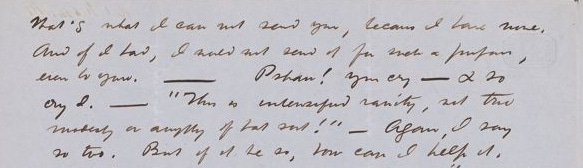
— Pshaw! you cry — & so cry I. —
Written from Pittsfield, Mass. in February 1851, Melville’s imaginary dialogue with his real friend supposes his friend’s contempt, disdain, or dislike of multiple refusals. Melville declined Duyckinck’s request that he write something for Holden’s Dollar Magazine, and re-refused to send him a daguerreotype portrait of himself, for a planned series on contemporary authors in that publication, recently acquired by Evert and his brother George L. Duyckinck.15
Back on the prairie, our Captain-narrator has to answer for his over-emotional engagement with the elk, referenced a bit later in the dialogue as “my pathos over the noble beast that had yielded his life to my sport.” In self-defense, he figures the scene as “gilding” applied to “Life’s bitter pill.” More generally, to gild the pill means to make something harsh or unpleasant look more attractive. The saying derives from the outmoded pharmaceutical practice of coating pills with silver or gold leaf, “done simply by moistening the pills with a thin coating of Albumen or Acacia solution and then revolving in a small globe in which leaves of silver or gold have been placed.”16
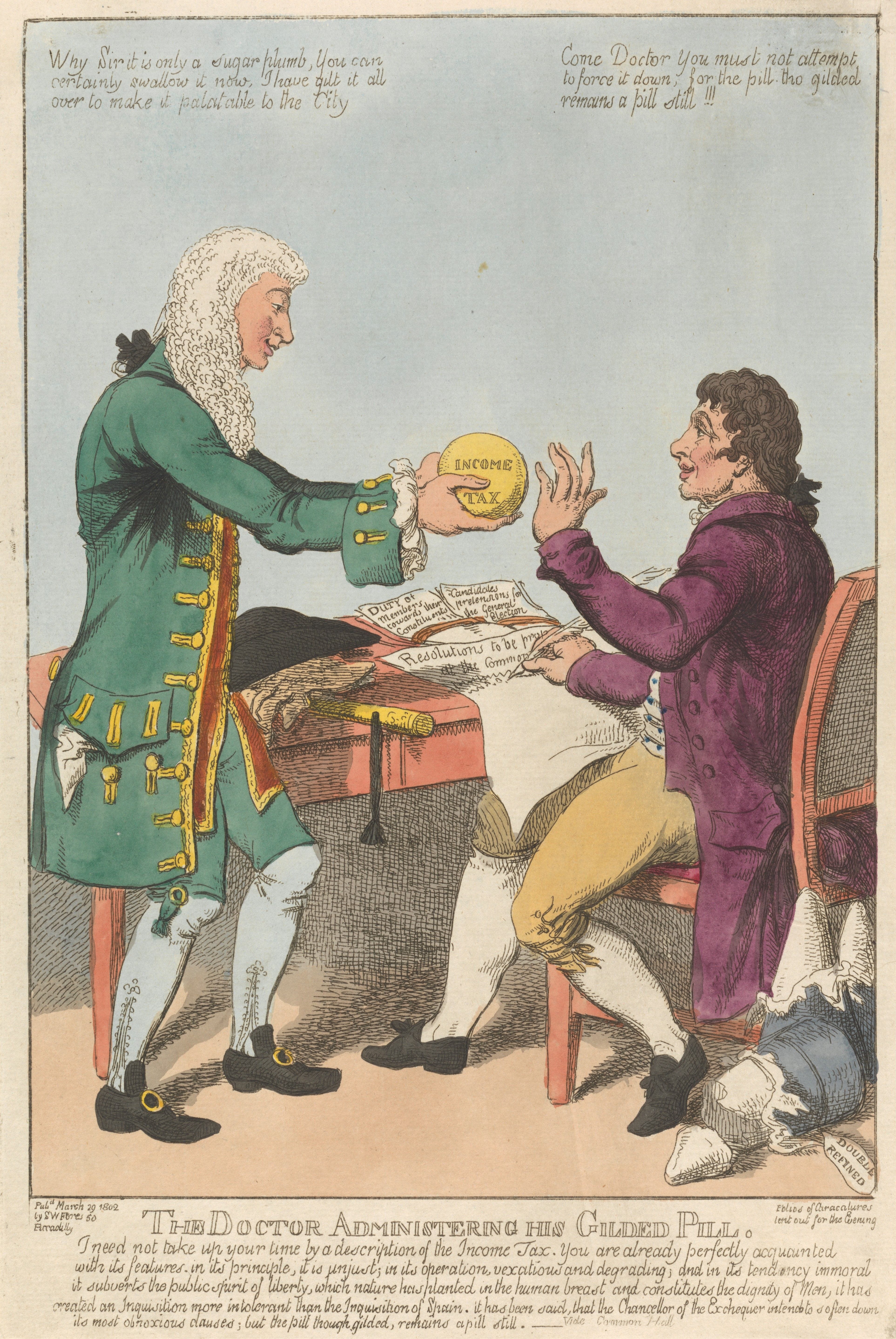
As here employed, the gilded-pill metaphor represents a piece of extra-passionate writing as gold leaf affixed by an apothecary to make unpleasant medicine more appealing and therefore, presumably, efficacious. One notable and thematically relevant use of the gilded pill as a metaphor for writing occurs in The Anatomy of Melancholy. In his Preface to the Third Partition on “Love Melancholy,” Robert Burton (in the guise of Democritus Junior) hopes that his literary efforts will be swallowed by the reader “like gilded pills, which are so composed, as well to tempt the appetite, and deceive the palate, as to help, and medicinally work upon the whole body” and, moreover, that his “lines shall not only recreate but rectify the mind.”17 Rather like the narrating Captain of U. S. Dragoons, Old Burton, too, administered the gilded-pill figure in reply to imaginary critics of his work.
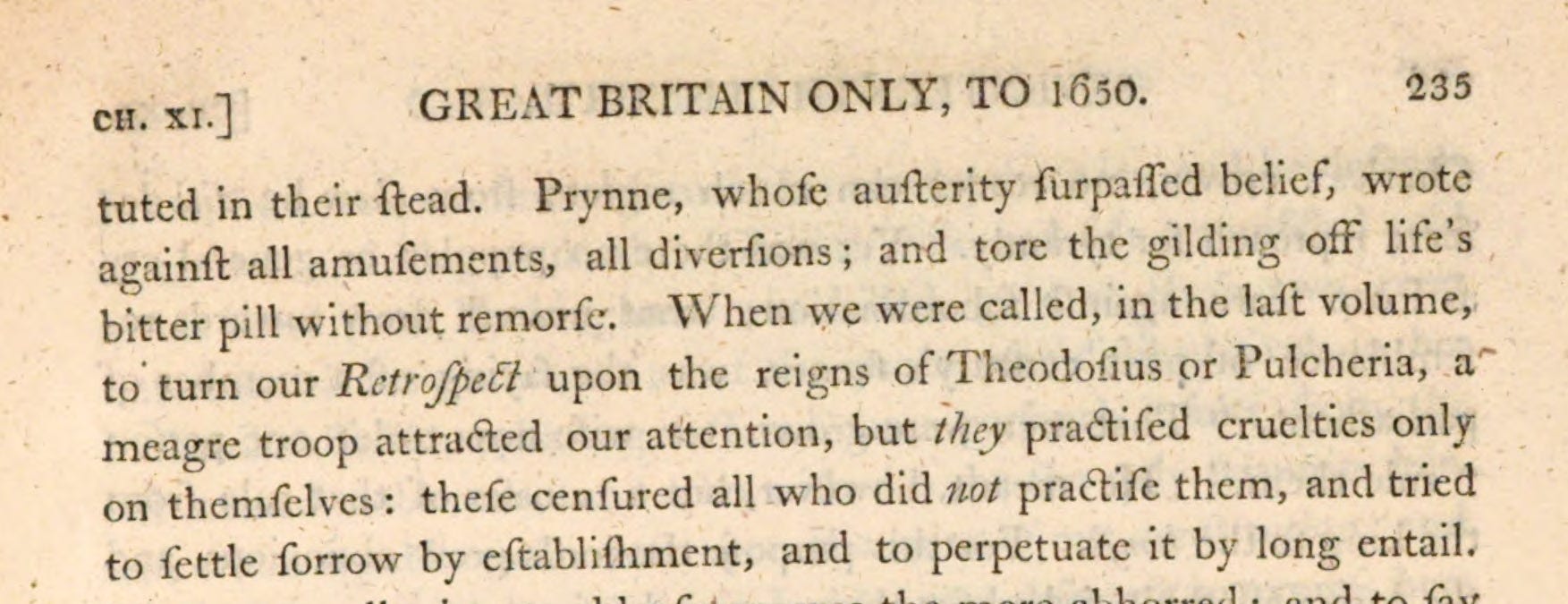
A more precise verbal match to the usage in “Scenes Beyond the Western Border” may be found in the second volume of Retrospection, the impressive two-volume survey of world history by Hester Lynch Piozzi.
“Prynne, whose austerity surpassed belief, wrote against all amusements, all diversions; and tore the gilding off life’s bitter pill without remorse.”18
In Retrospection the former Mrs. Thrale, famously intimate friend of Samuel Johnson, employed the gilded pill metaphor to call out Puritans generally and William Prynne specifically as extremist killjoys. Of course Mrs. Piozzi did not invent the figure of speech, or even this way of saying it. Nonetheless, it seems to me remarkable that a search in the online archive at HathiTrust Digital Library returns exact matches for the expression life’s bitter pill in just four places before 1860: the 2nd volume of Retrospection; the 18th volume of the Southern Literary Messenger; the 1857 edition of Scenes and Adventures in the Army; and the 1859 reissue of Scenes and Adventures in the Army.
With no overt reference to pills, Moby-Dick Chapter 114 The Gilder portrays deceptively pretty features in nature as artful gilding that can mask or temporarily distract from ghastly horrors below the surface of the ocean, and “of the earthy life.” Melville does not unmask the titular “Gilder” who might well be the Author—of Moby-Dick or all Creation.
Also worth observing, the capital letter “L” in the word “Life.”
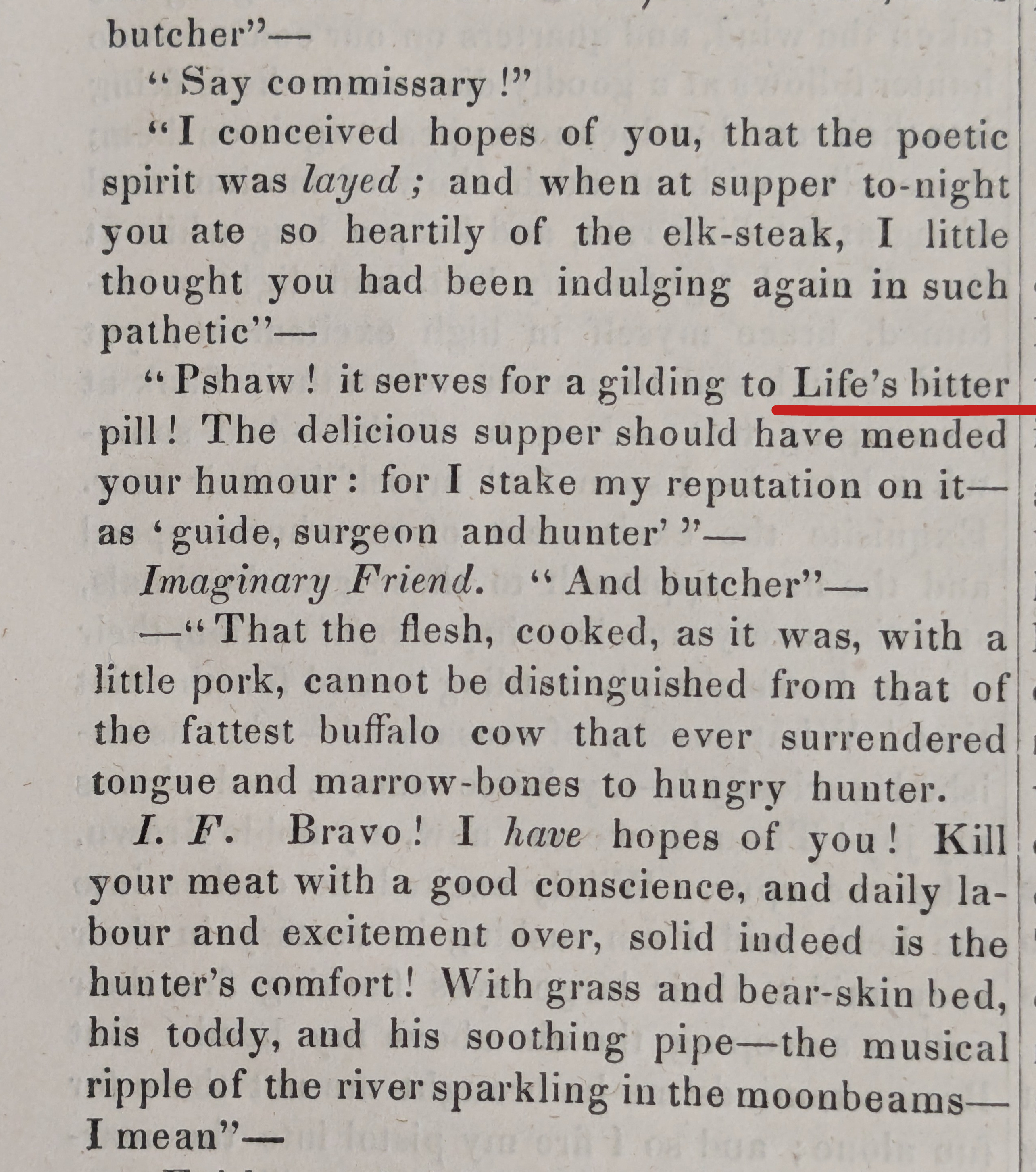
Revised in the book versions to “life’s bitter pill,” the 1852 text reads “… Life’s bitter pill.” Along with “Literature” in the cancelled synopsis on the front cover, “Life” also had a capital “L” in the fourth installment of “Scenes Beyond the Western Border” as originally printed in the Southern Literary Messenger. Hard evidence that Herman Melville took care to capitalize the first letter of the alliterating L-words Literature and Life exists in the manuscript version of his pseudonymous 1850 review essay, “Hawthorne and His Mosses.”19 As shown in the closeup below, Melville altered both of the lower-case forms previously rendered “literature” and “life” by his faithful wife and scribe, Elizabeth Shaw Melville.20
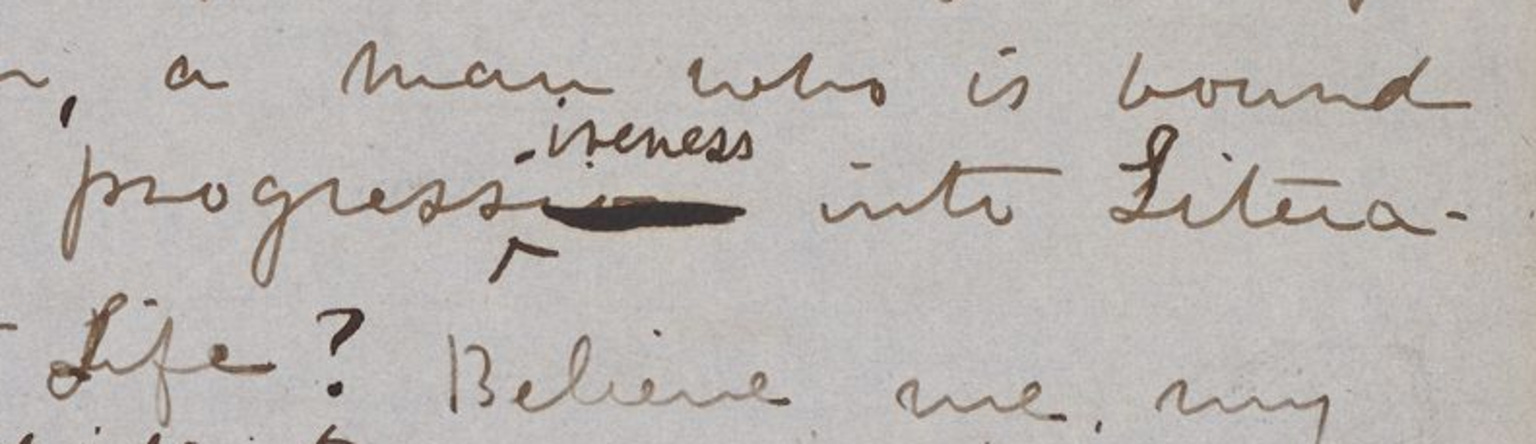
Both words were printed in the Literary World for August 17, 1850 as revised in manuscript by the author, “Literature” and “Life.”
Despite their aesthetic and philosophical differences, both speakers in the “After supper” dialogue agree, those elk-steaks were delicious. When the romance-prone Captain of U. S. Dragoons gives the supper two thumbs-up, his Imaginary (though ironically matter-of-fact) Friend congratulates him as a potential convert to materialism.
“Bravo ! I have hopes of you! ”
In its dialogic form, playful tone, and content equally meaty and metaphysical, the prairie banter “After supper” between the Captain-narrator and I. F. recalls a number of conversations among imaginary traveling companions in Mardi: and a Voyage Thither, “Melville’s first book of talk” as John Wenke has aptly characterized it.21 One particularly relevant sequence can be found in Volume 2 Chapter 67, They Visit One Doxodox, where King Media and the matter-of-fact historian Mohi comment in support of the sadly bedeviled philosopher Babbalanja, disillusioned after his shark-tale exposed the renowned “sage” Doxodox as a clown:
“Bravely done, Babbalanja!” cried Media. “You turned the corner to admiration.”
“I have hopes of our Philosopher yet,” said Mohi.
In the January 1852 installment of “Scenes Beyond the Western Border,” words and ideas ascribed to fictional characters in Mardi fuse into one extra-exclamatory line of dialogue, spoken by the narrator’s Imaginary Friend:
“Bravo! I have hopes of you!”
Along with the similar form and rhetorical context, Melville’s expression I+have+ hopes+of (a 4-gram) in the quoted sequence from Mardi immediately follows a close approximation in “Bravo !” where Melville had Media exclaim, “Bravely done…!” Whoever wrote or ghostwrote the “After supper” dialogue in “Scenes Beyond the Western Border” must have read and delighted in Mardi—where, as Mark Niemeyer has noted, “the whole movement of the narrative is towards the west.”22 And absorbed enough of Melville’s working vocabulary to produce an entertaining Mardi-style dialogue for readers of the Southern Literary Messenger.
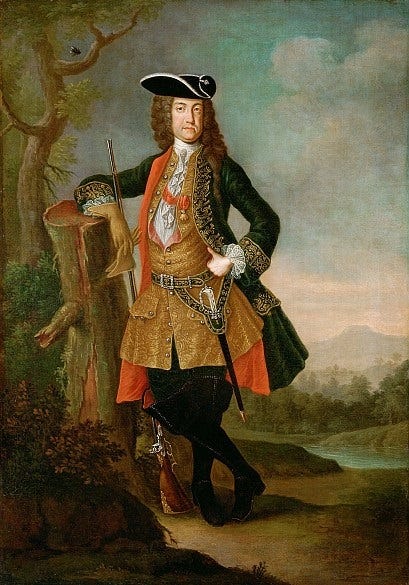
In another echo of Mardi, the perspective on wild game as the hunter’s “solid” and well-earned “comfort” advanced by I. F. matches that of Melville’s ideal Hapsburg ruler, allegorized as the bluff
“king of Hapzaboro; portly, pleasant; a lover of wild boar’s meat; a frequent quaffer from the can; in his better moods, much fancying solid comfort.”
I. F.’s view of supper as the laborer’s due and “comfort” echoes Melville himself in a letter to Hawthorne, written after receiving and speed-reading Hawthorne’s note (since destroyed or lost) with appreciative comments about Moby-Dick:
MY DEAR HAWTHORNE, — People think that if a man has undergone any hardship, he should have a reward; but for my part, if I have done the hardest possible day’s work, and then come to sit down in a corner and eat my supper comfortably—why, then I don’t think I deserve any reward for my hard day’s work— for am I not now at peace? Is not my supper good? My peace and my supper are my reward, my dear Hawthorne.23
Admittedly, the entertainment value of all the prairie dialogues in the second half of Scenes and Adventures in the Army, including this one, has not been generally appreciated. Understandably, most readers to date have approached the work as an important contribution to military biography and the history of the American West, not American literature. I aim to change that with closer attention to the invented conversations, long disregarded, between the narrating Captain of U. S. Dragons and his Imaginary Friend. One entertaining feature of the “After supper” dialogue now under consideration is the ironic turn or twist that happens when “I. F.” the Imaginary Friend gets so caught up in rapturous enjoyment of the delicious elk-steak, that he unconsciously adopts the language of sentimental and romantic poetry in praising the great meal and beautiful outdoor scenery. This twist is supposed to be funny because it ironically undercuts the Friend’s stated preference for facts over fancy, crucially manifested by his earlier censure of the Captain-narrator’s “double-refined poetry and romance.”
I. F…. With grass and bear-skin bed, his toddy, and his soothing pipe — the musical ripple of the river sparkling in the moonbeams — I mean —
“Fairly caught! I little thought when I heard you abuse my pathos over the noble beast that had yielded his life to my sport, that mere creature comforts would thus inspire you! Dear critic, and lover of bathos! hast thou found poetry in a full stomach?”
The tables are turned—in the Captain’s favor, as verbally signaled by his taunting phrase “I little thought….” uttered in mockery of the Friend’s criticism which began exactly the same way, “I little thought….”
I LITTLE THOUGHT
“I little thought, as I shuddered at the question, that in the space of a few weeks I should actually be a captive in that self-same valley.” — Typee, Chapter 4
“… I little thought what Fate had ordained for myself the next day.”
—White-Jacket Chapter 67, White-Jacket Arraigned at the MastFor Melville’s usage in a similar rhetorical context, to advance dialogue between two speakers, compare the address of Mr. Flask to Mr. Stubb in Moby-Dick Chapter 73, Stubb and Flask kill a Right Whale; and Then Have a Talk over Him: “But see here, Stubb, I thought you a little boasted just now, that you meant to give Fedallah a sea-toss, if you got a good chance.”
the bi-gram little + thought occurs 3x in Omoo; and 1x each in Mardi, Redburn, and Moby-Dick.
THE NOBLE BEAST
“Besides, the noble beast himself is growing old, and has a touching look of meditativeness in his large, attentive eyes.” — Pierre; or, The Ambiguities
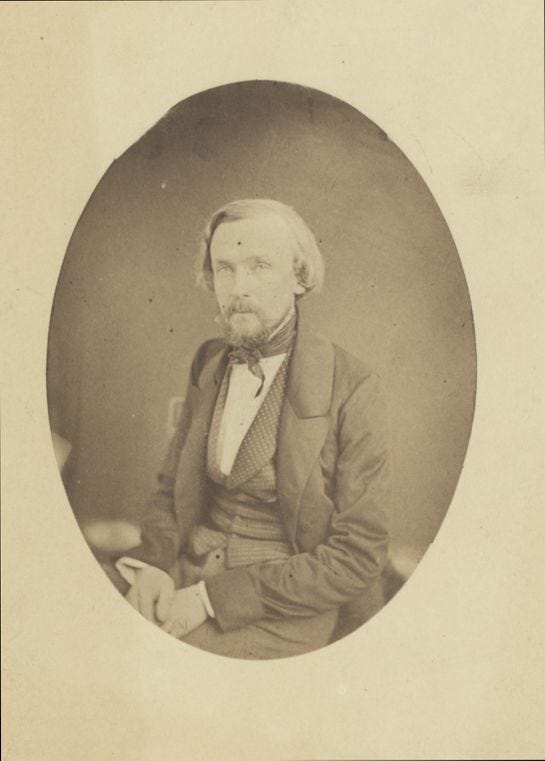
Dear critic Duyckinck
As shown in another chapter of the present study, criticism of G.P.R. James in the second prairie dialogue (originally labeled “Literature on the Little Arkansas”) in several places reworks arguments from 1850 articles in the New York Literary World, co-edited by Melville’s friends Evert A. Duyckinck and his younger brother George L. Duyckinck. On the lookout now for traces of Evert (as the brother closest to Melville) in the evolving characterization of “I. F.” the Captain-narrator’s imaginary traveling companion, I would note three suggestive elements in the Captain’s accusatory question:
Dear critic, and lover of bathos ! hast thou found poetry in a full stomach ?”
The Captain-narrator’s address of “I. F.” as “Dear critic” makes it official. From here on out, the speaker’s Imaginary Friend will be regularly enlisted as his imaginary “critic.” Evert Duyckinck, one of Melville’s best and most supportive friends ever, also served as his critic, “dear” though occasionally (and sometimes inconveniently) severe, too. Treating Mardi to a lavish two-part review in the New York Literary World (April 14 and 21, 1849) Duyckinck had ventured one reservation about the “poetical” and metaphysical content of conversations between the narrator’s imaginary friends Media, Babbalanja, Yoomy, and Mohi:
”The discourse of these parties is generally very poetical, at times quite edifying, excepting when they get into the clouds, attempting to handle the problem of the universe.”24
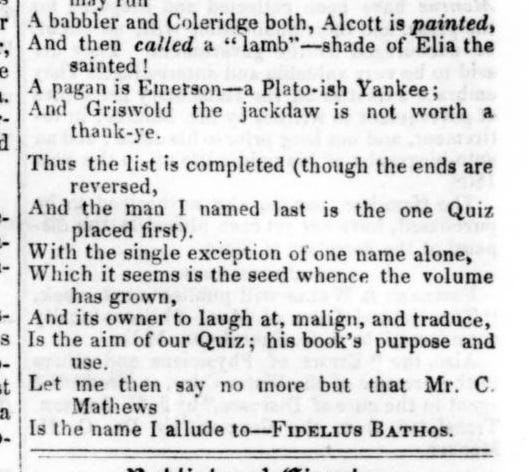
In his ecstasy over elk-steak, I. F. brings the bathos that comically deflates the Captain-narrator’s ultra-sentimental demonstration of pathos in the “painful scene” of the hunter’s final encounter with the “noble beast.” At least nominally and coincidentally, I.F. as a “lover of bathos” mimics the notorious promotion by Duyckinck of his close friend Cornelius Mathews, who in 1848 had contributed “A Rhyming Review” of Lowell’s A Fable for Critics to the Literary World over the pseudonym FIDELIUS BATHOS.25
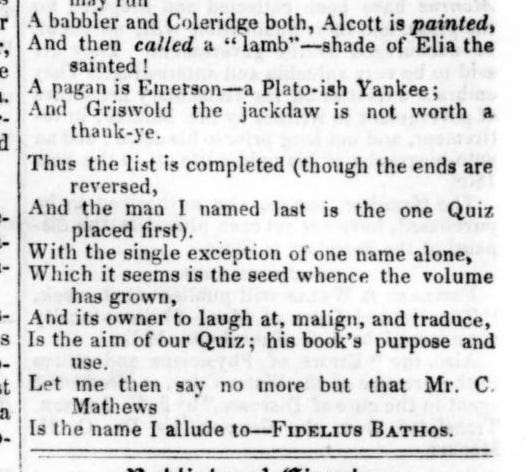
New York Literary World - November 25, 1848 Taking such great pleasure in “solid” food and “creature comforts” like pipe smoking and cocktail drinking, the narrator’s “dear critic” can’t help but wax poetic; hence the Captain-narrator’s playful speculation that I.F. may accidentally have discovered “poetry on a full stomach.” Melville’s critical friend Evert Duyckinck had a way of balancing the enjoyment of poetry and romance with pointed references to food and drink. Sometimes undercutting “the romance or whatever” through bathos, as exemplified in this account of a visit to Fort Lee with Herman Melville in July 1848:
I was out the other day to Fort Lee with Melville—a grand picnicking day. The first lady & gentleman we came upon were in front of a table cloth spread on a rock and covered with hams, sardines &c, affectionately mouthing to each other, the Lady of Lyons. They had just reached the “magnificent” Lake of Como passage "Dost like the picture lady?" A remark she let fall that champagne didn't inhale on an empty stomach distressed the romance or whatever it was. It was a tribute to literature notwithstanding.26
In Duyckinck’s eye the plentiful ham, sardines, and champagne seemed way more appealing than the rude “mouthing” of a passionate love-scene from Edward Bulwer-Lytton’s 1838 melodrama the Lady of Lyons. Needful care for “the stomach” features in Duyckinck’s report of another summer excursion, his ascent of Mount Greylock aka “Saddleback” in August 1851 with “a party of eleven” that again included Herman Melville:
“To dinner—spread on boards in the damp saturated sleeping story of the Observatory. How that Heidsieck is emptied into the silver gilt mug and the throats of the company! How those multitudinous layers of ham disappear and well they may—for when you go up into the heavens 3500 ft you must strengthen the stomach.”27
There goes another wolf “concert”
To the charge of finding poetry in a full stomach, I. F. replies, “The devil’s in the moon,” quoting from Lord Byron’s Don Juan Canto 1, stanza 113: “The devil’s in the moon for mischief.” Byron, devil, and moon are all indicted as influencers of the Imaginary Friend’s uncharacteristically romantic effusion.
I. F. “The devil’s in the moon. — And there goes another wolf ‘concert’” —
“With the thorough bass of a thousand bulls.”
On cue, the invocation of Byron touches off “another wolf ‘concert,’” a sort of encore to the “wild and mournful howling” that had prompted the narrator’s ultra-romantic soliloquy in the December 1851 installment of “Scenes Beyond the Western Border.” With the wolves back on stage, another such rhapsody from the Captain-narrator may be imminent. Alluding to the last one, I.F. sarcastically rejects the narrator’s previously stated claim for wolf howling as “natural concert music,” now equating it with the harsh “braying” of asses.
I. F. — “All as thoroughly musical as the donkey braying in the caravan camps. I wish you a very good evening, ‘and a little better taste.’”
Making his exit, I.F. wishes for the Captain-narrator “a little better taste,” directly quoting the Archbishop’s parting shot at Gil Blas in Book 7 Chapter 4 of the Adventures of Gil Blas of Santillane by Alain René Le Sage.28 The too-Veracious Secretary lost his cushy job as personal assistant and scribe after he unwisely commented on the reduced vigor of his employer’s latest homily. Completely and comically unflappable, the Archbishop faulted Gil Blas, not for truth-telling, but for having inadequate powers of discernment, a weakness exposed in his being unable to perceive the finer points of a great literary production. As here applied by I.F., the Archbishop’s line in Gil Blas faults the Captain-narrator for the lack of discernment evident in mistaking the howling of wild animals for music.
By way of rewarding the exceptionally patient and discerning reader who has journeyed this far into the present chapter of DRAGOONED, I would offer “there goes another” in the “After supper” dialogue as a really good instance of writing like Herman Melville. Exemplified in Mardi and Moby-Dick, the formula there goes _______ lends texture and immediacy to any line of dialogue, whether spoken in reference to puffs of smoke, bedspreads, metal jingles, ship’s cables, tarpaulins, or the howls of prairie wolves.
THERE GOES ANOTHER
"Ay, there they go," cried Mohi, "there goes another—and there, and there—” Mardi Volume 2 Chapter 17, They Regale Themselves with their Pipes
there goes another counterpane. Chapter 17 The Ramadan
PIP. Jinglers, you say?—there goes another, dropped off; I pound it so. Chapter 40 Midnight, Forecastle
Crish, crash! there goes the jib-stay! Blang-whang!
Halloa! whew! there goes my tarpaulin overboard. Chapter 121 Midnight. The Forecastle Bulwarks
Ascending smoke
Between the exit of I.F. and solitary musings on beauty and terror in the “incomprehensible scheme” of Creation, a one-sentence transition is provided by the never-identified stage manager or director who set up the After supper dialogue in the first place, by introducing the Captain-narrator in the third person as “the Hunter.” This second, transitional reference to the narrator as “the hunter” completes the frame of the dialogue and makes a neat segue to the dramatic monologue that follows.
The hunter, gazing apparently upon his ascending smoke—as if of incense—indulges in soliloquy.
Thus figured as “incense,” the “ascending smoke” (either from the hunter’s pipe, as before, or possibly his campfire) signals the enactment of a holy ritual of some kind. Subsequent allusions to Scripture, quoting from Genesis 1.2 (“the Spirit of God moved upon the face of the waters”) and Seraphim heighten the feeling of a religious service.
Developing a similar image with much the same language in Moby-Dick Chapter 102 A Bower in the Arsacides, Ishmael claims to have personally witnessed “smoke ascending” from the skull of a whale, artfully transformed into an altar.
Now, when with royal Tranquo [king of Tranque] I visited this wondrous whale, and saw the skull an altar, and the artificial smoke ascending from where the real jet had issued….
As reported by Melville’s narrator, religious leaders at Tranque “kept up an unextinguished aromatic flame, so that the mystic head again sent forth its vapory spout.” The “jet” spouted from that whale-skull altar was in reality incense, the “artificial” product of an “aromatic flame” tended backstage by priests.
Fanned by seraphic spirits
Another religious image in the moonlight soliloquy after “After supper” is the vision of guardian angels fanning the air breathed by mortal creatures on earth.
“The air, methinks, is fanned by seraphic spirits on their winged errands of Peace!”
Key elements of this imagery look back to a late chapter in Mardi titled “A Book from the ‘Ponderings of Old Bardianna.”29
“Even now, we may be inhaling the ether, which we fancy seraphic wings are fanning.”
Specific elements replicated in the January 1852 installment of “Scenes Beyond the Western Border” are
“the air,” in context synonymous with “the ether”
“fanning” or “fanned”
by “seraphic” non-human beings
“winged” or with “wings”
In this instance, comparable to the fusion of consecutive speeches by Media and Mohi exhibited in I.F.’s line, “Bravo! I have hopes of you !” the quality of correspondences to Melville’s writing is high, and striking. Uncredited influence, bordering on plagiarism, would normally offer the best, most reasonable explanation for such close correspondences to Mardi, published nearly three years before the first appearance in print of this episode from the 1851-3 magazine series, “Scenes Beyond the Western Border.” However, copying Melville does not account very well for the close verbal and conceptual correspondences to Moby-Dick; the first American edition would not have been accessible until the middle of November 1851, less than two months before the January 1852 issue of the Southern Literary Messenger hit bookshops and newsstands. Nor could unacknowledged borrowing from Melville account for anticipatory hints of his unpublished novel Pierre, examined elsewhere in the present study, for example in As a sailor might say and Literature on the Little Arkansas.
As shown herein, correspondences to Moby-Dick in this installment of “Scenes Beyond the Western Border” include sustained focus on hunting, butchery, and meat-eating, and the Captain-narrator’s sentimental profile of a stricken elk in words and images that—ironically—Melville used to make Ahab appear more human and more pitiable in his suffering. Textual matches to Melville’s then-recent writing in Moby-Dick recall Stubb’s supper of whale-steak (Chapter 64); the ascending smoke of burning incense on the whale-skull altar in Tranque (Chapter 102); and the deceptively beautiful gilding of Nature’s surfaces on display in “The Gilder” (Chapter 114).
I guess that’s more than enough writing like Melville. For now anyway. I hoped to finish up the January 1852 number with my reading of the “After Supper” dialogue, and make a fresh start next time with new matter, all about the 1845 expedition by U.S. Dragoons to the South Pass of the Rocky Mountains. But somehow I have neglected to mention another trace of The Gilder, visible in the Captain’s enthusiastic commendation of 110 Mile Creek. The best is yet to come!
As given in the Table of Contents, the “Soliloquy” part of “Dialogue and Soliloquy” in Chapter 5 of Scenes and Adventures in the Army designates the romantic apostrophe to mother nature, directly addressed using the second-person familiar pronoun form thou, as “thou beautiful and wonderful Nature!”
In the 1859 re-issue of Scenes and Adventures in the Army, only the title page has been revised to acknowledge author P. St. G. Cooke’s recent promotion to “Colonel Second Dragoons, U.S.A.” The 1857 title page gave the author’s military rank as “Lieutenant-Colonel Second Dragoons, U.S.A.”
Mardi: and a Voyage Thither (New York: Harper & Brothers, 1849) Volume 2 Chapter 80, Morning, pages 342-343.
Edgar A. Dryden, Melville’s Thematics of Form: The Great Art of Telling the Truth (Johns Hopkins University Press, 1968) page 29. <https://archive.org/details/melvillesthemati0000dryd/page/28/mode/2up>
“Life” with capital “L” is altered to “life” in the 1857 book version.
A major change in the 1857 book version is the deletion of all references to the narrator’s companion as “Imaginary,” including abbreviations of “Imaginary Friend” to “I.F.” References to the narrator’s friend as “Frank” in August 1852 and later installments of “Scenes Beyond the Western Border” were also cut. After revision, the invented speaker in every dialogue is identified simply as “Friend.”
Enjoyment of whale-steak, so denominated, is referenced in a footnote “upon the subject of eatables” by Robert Anstruther Goodsir in An Arctic Voyage to Baffin’s Bay and Lancaster Sound, in search of Friends with Sir John Franklin (London: John Van Voorst, 1850) at page 93. Goodsir sailed in the whaleship Advice with Captain Penney. <https://archive.org/details/anarcticvoyaget00anstgoog/page/n108/mode/2up>
“Two Sides to a Tortoise,” the second sketch in Melville’s series “The Encantadas, or Enchanted Isles” first appeared in the March 1854 issue of Putnam’s Monthly Magazine, at pages 313-314.
William B. Dillingham, Melville’s Short Fiction, 1853-1856 (University of Georgia Press, 1977) page 83.
“A Journal of the Santa Fe Trail--(Concluded)” edited by William E. Connelley in the Mississippi Valley Historical Review, volume 12, number 2 (1925) pages 227–255 at page 244. JSTOR, https://doi.org/10.2307/1886514.
William E. Connelley, ed., “A Journal of the Santa Fe Trail--(Concluded)” pages 253-254.
Reflections on the essential “poetic nature” of Pierre appear near the start of Book 17, “Young America in Literature,” introducing what seem to be late additions the manuscript. On the composition and expansion of later chapters with added material, see Chapter 6, “Cobbling the Harper Pierre: January-February 1852” in Brian Higgins and Hershel Parker, Reading Melville’s Pierre; or, The Ambiguities (Louisiana State University Press, 2006) pages 144-174.
Quoted from Mardi: and a Voyage Thither Volume 1 Chapter 65, Taji Makes Three Acquaintances.
Quoted from Mardi: and a Voyage Thither Volume 2 Chapter 66, A Flight of Nightingales from Yoomy’s Mouth. Traveling in Europe Melville purchased a volume, now lost, titled Lays and Legends of the Rhine by James Robinson Planché (London: Goulding & d’Almaine, 1832); Sealts Number 404.1 in the “Catalog of Books and Documents Owned, Borrowed and Consulted by Herman Melville” at Melville’s Marginalia Online. FSU Digital Repository has a very nice virtual copy, not the book Melville bought in Coblenz in December 1849 but the same edition, accessible online here: http://purl.flvc.org/fsu/fd/FSU_PR5187P2L31832.
Imagined as a vocal protest of something Melville said, each of the two exclamations of “Pshaw!” recorded in Melville’s extant correspondence is ascribed to the recipient of the letter in which it occurs: John Murray the London editor (March 25, 1848) and Evert A. Duyckinck the New York critic and Melville’s good friend (February 12, 1851). The additional, implied “cry” of “Pshaw!” in Melville’s 1851 letter to Duyckinck is conceived to be Melville’s retort, answering the “Pshaw!” ascribed to Duyckinck. Both these letters are printed in Herman Melville’s Correspondence, edited by Lynn Horth (Northwestern University Press, 1993) at pages 105-108 and 178-182. Also in the Letters of Herman Melville, edited by Merrell R. Davis and William H. Gilman (Yale University Press, 1960); for instances of “Pshaw!” see pages 70 and 120.
Fenner’s Complete Formulary, Ninth Edition (Westfield, New York: B. Fenner, 1892) page 682.
Melville’s lost copy of the Anatomy of Melancholy is Sealts Number 102 in the “Catalog of Books and Documents Owned, Borrowed and Consulted by Herman Melville” at Melville’s Marginalia Online. Another volume of Burton’s classic work (formerly owned and sold by Herman’s father Allan Melvill) is extant; Sealts Number 103. Burton’s passage on sentences of writing as “gilded pills” for the benefit of mind and body is extracted in The Doctor, &c. by Robert Southey, long recognized as a model for the “Extracts” and other matter in Moby-Dick; Number 657 in Mary K. Bercaw, Melville’s Sources (Northwestern University Press, 1987) page 121. Southey’s influential miscellany is frequently cited in the 1952 Hendricks House edition of Moby-Dick; or, The Whale, edited by Luther S. Mansfield and Howard Vincent.
Hester Lynch Piozzi, Retrospection: or, A review of the most striking and important events, characters, situations, and their consequences, which the last eighteen hundred years have presented to the view of mankind (London: J. Stockdale, 1801) 2 volumes. Reference to “gilding” of “life’s bitter pill” appears in Volume 2 on page 235.
Published in two parts under the pseudonym of “A Virginian Spending July in Vermont” in the New York Literary World for August 17 and 24, 1850. Images of the fair copy made by Elizabeth Shaw Melville with the author’s corrections and additions are accessible via Manuscripts and Archives Division, The New York Public Library. "“Hawthorne and his mosses”" The New York Public Library Digital Collections. 1850. https://digitalcollections.nypl.org/items/3dcaace0-fca6-0132-a2c7-58d385a7b928
Ascribed to Herman, both changes—from “literature” to “Literature” and “life” to “Life”— are recorded among “Manuscript Alterations” at page 679 in the Northwestern-Newberry volume, The Piazza Tales and Other Prose Pieces, 1839-1860, edited by Harrison Hayford, Alma A. MacDougall, G. Thomas Tanselle, and others (Northwestern University Press, 1987).
<https://archive.org/details/piazzatalesother0009melv/page/679/mode/1up>
John Wenke, Melville’s Muse: Literary Creation & the Forms of Philosophical Fiction (Kent State University Press, 1995) page 48. <https://archive.org/details/melvillesmuselit0000wenk/page/48/mode/2up>
“An American Quest for Truth in the Mid-Nineteenth Century: Herman Melville’s Mardi: and A Voyage Thither” in La revue Épistémocritique Volume 10 – Fictions du savoir, savoirs de la fiction. <https://epistemocritique.org/an-american-quest-for-truth-in-the-mid-nineteenth-century-herman-melvilles-mardi-and-a-voyage-thither/>
First printed by Rose Hawthorne Lathrop in Memories of Hawthorne (Houghton, Mifflin and Company, 1897) at pages 156-160.
Reprinted in Herman Melville: The Contemporary Reviews, edited by Brian Higgins and Hershel Parker (Cambridge University Press, 1995) page 218. <https://archive.org/details/hermanmelvilleco0000unse/page/218/mode/2up>
“A Rhyming Review" by “Fidelius Bathos” [Cornelius Mathews] appeared in the Literary World for November 25, 1848 on page 855.
<https://archive.org/details/sim_literary-world_1848-11-25_3_95/page/855/mode/1up>
Cited in the online version of James Russell Lowell’s A Fable for Critics, edited by Alex Zweber Leslie. Last modified March 2021. https://azleslie.com/fableforcritics/.
For biographical and literary contexts see my blog post “Melville at Fort Lee with Evert Duyckinck in 1848,” accessible here:
https://melvilliana.blogspot.com/2016/10/melville-at-fort-lee-with-evert.html
Evert A. Duyckinck to Margaret Panton Duyckinck, 13 August 1851 in Melville in His Own Time (University of Iowa Press, 2015) page 64.
The Adventures of Gil Blas is Number 444 in Melville’s Sources by Mary K. Bercaw. The testimony of Doctor Zogranda in Moby-Dick Chapter 65 the Whale as a Dish in favor of whale blubber (“juicy and nourishing”) as baby food, satirizes William Scoresby, Jr., but his name devolves from Dr. Sangrade in Le Sage’s Gil Blas. First identified as Melville’s source by Willard Thorp in his 1947 edition of Moby-Dick for Oxford University Press.
In Herman Melville: Stargazer (McGill-Queen’s University Press, 1998) at pages 40-41, Brett Zimmerman observes that in Mardi the philosopher Babbalanja and Melville’s narrator Taji similarly view “the cosmos” as “a vast hierarchy of both physical existents and metaphysical essences (referred to in the book as ‘shades,’ ‘spirits,’ ‘seraphs,’ ‘angels,’ and ‘archangels’).”