
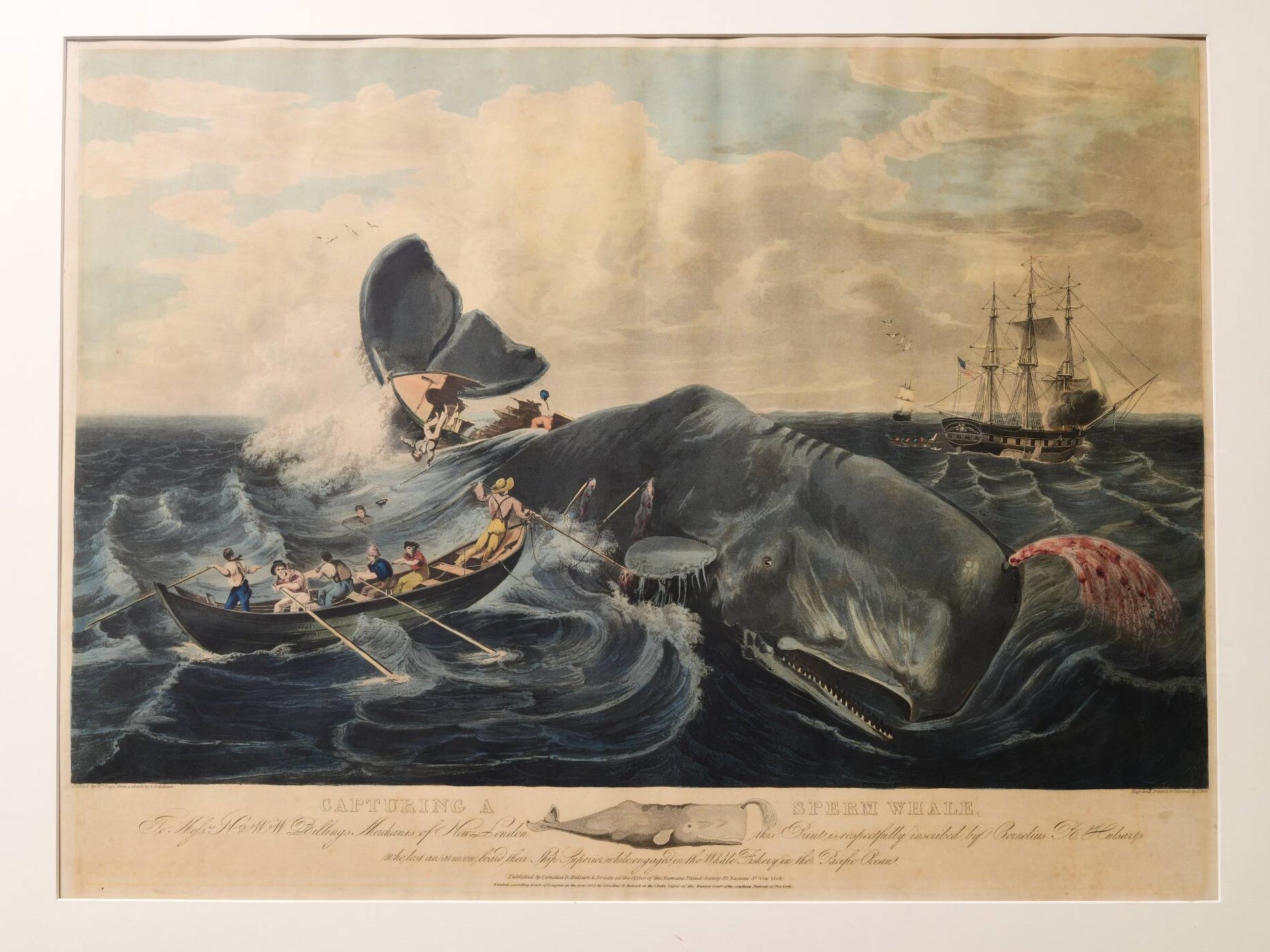
Capturing a sperm whale
Re-presenting the animated 1823 description by Henry J. Pickering aka "Thomas H. Bennett"

The thrilling description of the chase and capture of a sperm whale given below first appeared in the Nantucket Inquirer for July 1, 1823 under the modest headline, “WHALING.”
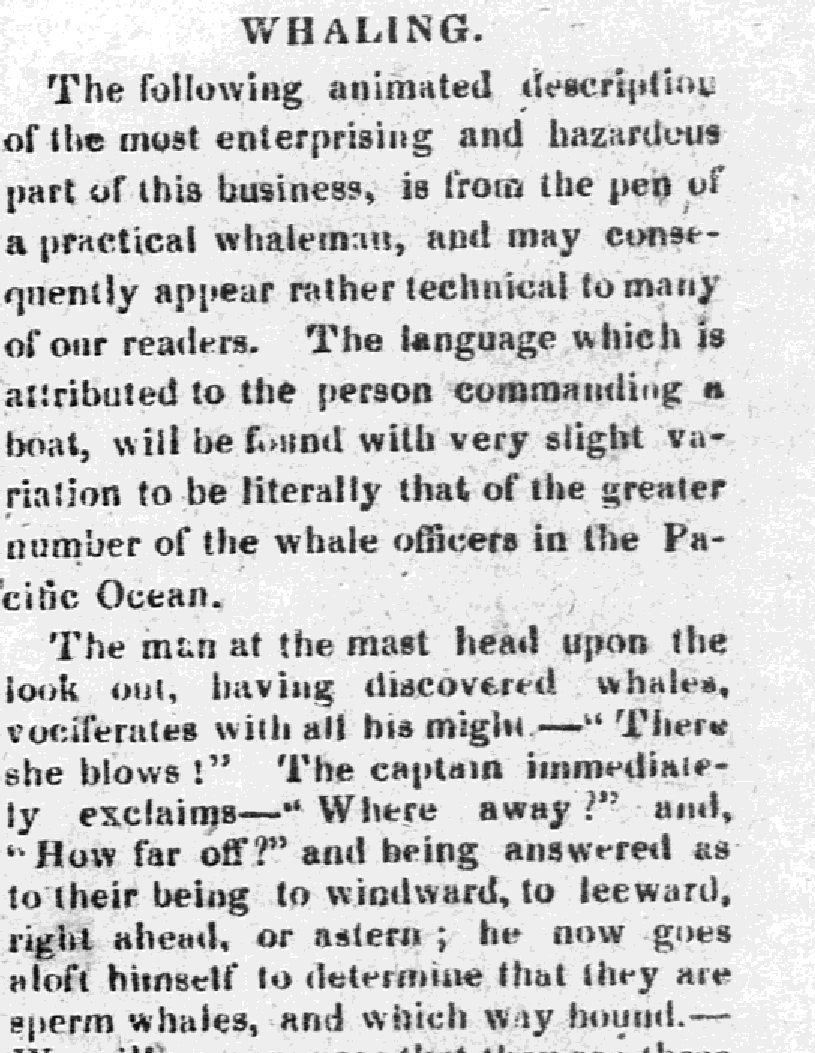
Although long known to specialist book dealers and historians of the whaling industry, this lively narrative deserves wider appreciation for its own merit, and as an obvious analogue (and possible source?) for similar scenes in Moby-Dick. The officer in command of the whaleboat, as quoted by the originally anonymous narrator:
“… lay back, I tell ye (fiercely) — why don’t ye spring— don’t let that boat pass ye (despondingly) — spring, I tell ye”
sounds a little like Melville’s Mr. Stubb and a lot like Captain Peleg of Nantucket, exhorting the crew to heave up the anchor in Chapter 22 Merry Christmas:
“Why don’t ye spring, I say, all of ye—spring!”
No surprise, since this is “literally” how most mates of whaleboats talked, according to the 1823 narrative. I am glad to put it back into the mix of authentic first-hand accounts of whaling adventure. And pleased as well to clear up a little authorship mystery by positively identifying the writer as hard-luck printer, newspaper editor, and ex-whaleman Henry Joseph Pickering, a native Brit formerly known as “Thomas H. Bennett.” Pickering’s graphic account concluded a section titled “Of Whaling” at the end of his 1823 pamphlet A Voyage from the United States to South America, performed during the years 1821, 1822, & 1823, issued in Newburyport, Massachusetts by the Herald press. Extracts from this work including the section “Of Whaling” had originally appeared in successive numbers of the Nantucket Inquirer, starting on April 29, 1823. In September 1824 a “Fifth Edition” of the same narrative was issued in Boston under the title, Chili and Peru in 1824.
All of the exciting “Whaling” narrative would be reprinted in the Rover Volume 2 on pages 250-251, without credit to any author. In the 20th century, Elmo Paul Hohman reprinted it from A Voyage from the United States to South America in The American Whaleman: A Study of Life and Labor in the Whaling Industry (Longmans, Green and Co., 1928) at pages 203-205. Text below likewise derives from A Voyage from the United States to South America, pages 79-80:
The following description of the most enterprising and hazardous part of the business of WHALING, was originally written by the Author for the Nantucket Inquirer. Although the language is somewhat technical, it may serve to shew with what intenseness of feeling the officers of a boat regard the whales while in pursuit. The language which is attributed to the person commanding a boat, will be found with slight variation, to be literally that of the greater number of the whale officers in the Pacific Ocean.
The man at the mast-head upon the look-out, having discovered whales, vociferates with all his might, “ THERE SHE BLOWS ! “ The captain immediately exclaims— “Where away?” and “How far off?” When being answered as to their being to windward, to leeward, right ahead, or astern, he goes aloft himself to determine that they are sperm whales, and which way bound. We will suppose that they are three points off the larboard bow, distant about 4 miles, and heading along the same course as the ship. Now the captain cries, “Keep her off two points,” which being done, “Steady—steady as she goes,” is his next order. “The weather braces a small pull.” “Loose top-gallant-sails, bear-a-hand.” Scarcely a man is to be found on deck after these orders are executed, except the helmsman; all are eagerly jumping aloft to catch sight of the whales previous to their going down; and hope and fear are alternately expressed in the faces of each, as the fish are seen to glide through the water rapidly, and in a straight course, or occasionally to play upon the surface — to lobtail it, is the technical term. The ship nearing the whales, the next order is, “See the lines in the boats!” “Swing the cranes!” The after-oarsman now fills his boat-keg with water, puts some bread under the stern sheets, and sees that a bucket is in the boat. We will imagine that the whales are now sounding, and that the captain, having run down with the ship as near as he thinks advisable, has ordered the main-topsail to be backed. All hands are now straining their optics to discover the whales when they first blow. They are at length seen a short distance from the ship. “Stand by the boats, there ,” cries the captain, and each man, knowing his station, is found at his respective boat, eager for the chase. “Lower away“ — the boats are precipitated into the water, and the crews are at their oars in a twinkling . After pushing from the ship, it takes some 2 or 3 minutes for the harpooner to adjust his craft, he then seats him on his thwart, and takes his oar. Now the officer who heads the boat, speaks, “Line your oars, boys, and pull ahead — (a lapse of two or three minutes ) — pull ahead, I tell you, why don’t ye — Oh, how they lay, heads and points, look at ‘em—pull ahead, I tell ye — long and strong, head boat, I say (an interval of about 60 seconds) — every man do his best— lay back, I tell ye (fiercely) — why don’t ye spring— don’t let that boat pass ye (despondingly) — spring, I tell ye (authoritatively) there, there they be, round and round with ‘em, for God’s sake pull ahead (entreatingly) — (lapse of a few seconds)—every thing — every thing I’ve got in my chest I’ll give ye, do spring boys, let’s go on first. Now then, back to the thwarts, give her the touch; I feel ye (encouragingly) five seas off, but five seas off, spring! — 3-oar side best; pull all, pull every soul of you (boisterously)— I’ll give you all my tobacco, every thing I’ve got— look at her, O, what a hump, and slow as night— don’t you look round (passionately) — I tell you she don’t blow, she only whiffs it out — at the end of your thwarts, pull, and we’ll be on this rising—she’s an 80-barrel whale; there she mills; by jingo she’s heading to leeward; a large fellow separate from the school (shoal) — why the harry don’t you pull — now do boys, do your best, won’t you (soothingly ) — I tell you we are jam on to her! One minute more! Half a minute! — O, boys, if you want to see your sweethearts, if you want to see Nantucket (with emotion), pull ahead—spring, b——t ye, that whale will shorten our voyage six months—I tell you we gain her fast —now’s the time—mills still—heading to leeward—slap on to her in a moment — harpooner stand by—all my tobacco—all my clothes—every thing that I possess—pull— O what a whale (softly) — I’ve hove my soul out —harpooner —— harpooner—— harpooner * * * *—one minute more lay back; spring half a minute more; all my tobacco, a double share of grog—we are in her wake — (whispers) make no noise with your oars ——— —— STAND UP HARPOONER—pull the rest—GIVE IT HER SOLID !
* * * * * * * Stern, stern I tell ye (loudly) — stern all, stern like the devil — stern, and get clear of the whale — harpooner come aft—wet the line there, you 2nd oarsman, we are fast—there she’s up, there she spouts, now haul me on — stern, stern I tell ye — lay to leeward of the whale —that’s a good one (straightens his lance) —lay the head of the boat off—I’ve bon’d my lance d ― n her—give me a chance, won’t ye; do haul me on, will ye—there’s the FLAG, She spouts Blood—stern, I tell ye — lie— give us a set upon her —thick as tar, there she clotters — stern, she’s going in her flurry — stern all — there, she’s fin up; pass the spade forward, let’s haul up to her, get harness on, and tow her alongside.”
Authorship
As recorded in A Checklist of American Imprints for 1823 and 1824, the earliest bibliographic records we have identify Thomas H. Bennett as the author of A Voyage from the United States to South America and the later Boston edition, re-titled Chili and Peru in 1824.1 Thomas H. Bennett is named as the author in a penciled note on the title page of the rebound, ex-library copy currently being offered by Open Boat Booksellers of Amherst, Mass; and also by the Library of Congress, evidently on the basis of a similar note in its copy of Chili and Peru in 1824, the “Fifth Edition” issued in Boston. More specifically identified as “a printer of Boston,” Thomas H. Bennett is credited as the author of Chili and Peru in 1824 by William Cushing in Anoyms: A Dictionary of Revealed Authorship (Cambridge, Mass., 1889) on page 113.
As noted in the library catalog of the American Antiquarian Society, the great Bibliotheca Americana, A Dictionary of Books Relating to America by Joseph Sabin references copyright holder Washington Chase as an alternative candidate for authorship of A Voyage from the United States to South America.
The designated copyright holder “Washington Chase,” if that name was correctly registered in 1823, may have been a clerk or other employee of the Newburyport Herald, the Massachusetts newspaper press that first issued A Voyage from the United States to South America in pamphlet form. Nevertheless, early attributions of both titles, A Voyage from the United States to South America and Chili and Peru in 1824, to Thomas H. Bennett were correct. At the time of their publication, the author was indeed known as Thomas H. Bennett.
As I will show, the 20th century attribution to Henry Bradley, influentially endorsed by Edward J. Lefkowicz (duly recognized as “America’s premier maritime book dealer” by Greg Gibson, proprietor of the fabulous Ten Pound Island Book Co.) and currently accepted by the American Antiquarian Society is wrong, or at best misleading.2 Two related items, both unknown before now, together establish the authorship of A Voyage from the United States to South America and subsequent versions by Henry Joseph Pickering, the adventurous printer formerly known as Thomas H. Bennett.
In November 1833, the fact of H. J. Pickering’s authorship was very plainly and credibly stated by Ephraim Williams Allen, owner and editor of the Newburyport Herald, the publisher of A Voyage from the United States to South America. Allen told who wrote the “admirably graphic” account of capturing a sperm whale by way of introducing the similarly vivid description of a recent meteor shower by the same author.3 Commended in reprinting by Allen, the effusion over “Falling Stars” had previously appeared in the Old Countryman, a newspaper for British and Irish emigrants that H. J. Pickering co-edited with Edgar W. Davies. From the Newburyport Herald of November 26, 1833 (emphasis mine):
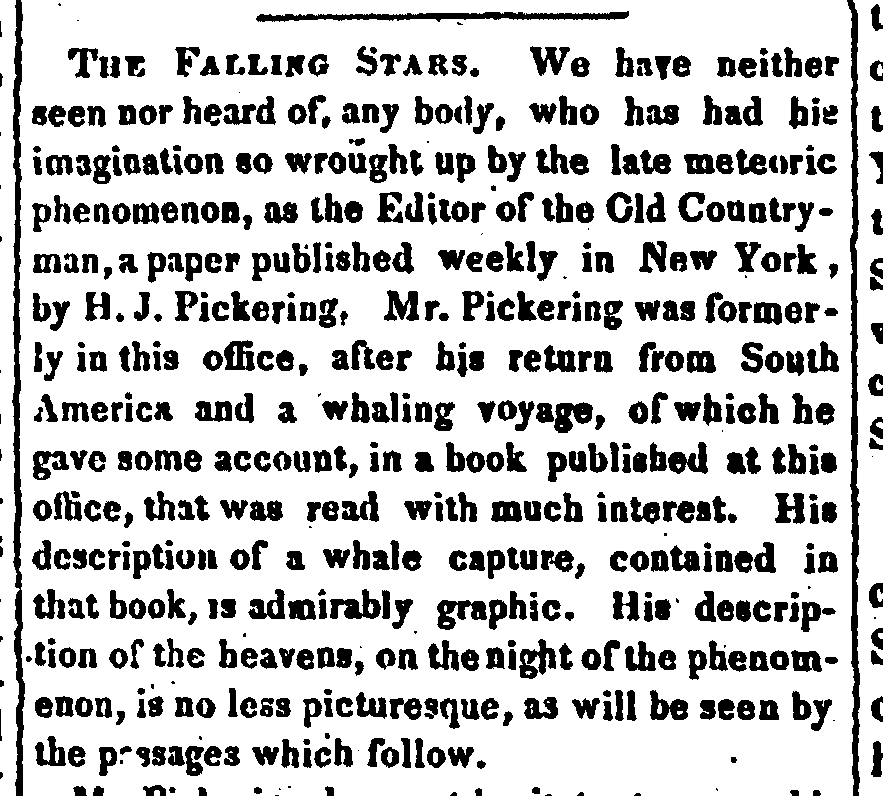
THE FALLING STARS. We have neither seen nor heard of any body, who has had his imagination so wrought up by the late meteoric phenomenon, as the Editor of the Old Countryman, a paper published weekly in New York, by H. J. Pickering. Mr. Pickering was formerly in this office, after his return from South America and a whaling voyage, of which he gave some account, in a book published at this office, that was read with much interest. His description of a whale capture, contained in that book, is admirably graphic. His description of the heavens, on the night of the phenomenon, is no less picturesque, as will be seen by the passages which follow.
Ex-whaleman H. J. Pickering was formerly known as “Thomas H. Bennett,” as revealed in this 1828 legal notice reprinted in multiple Massachusetts newspapers:
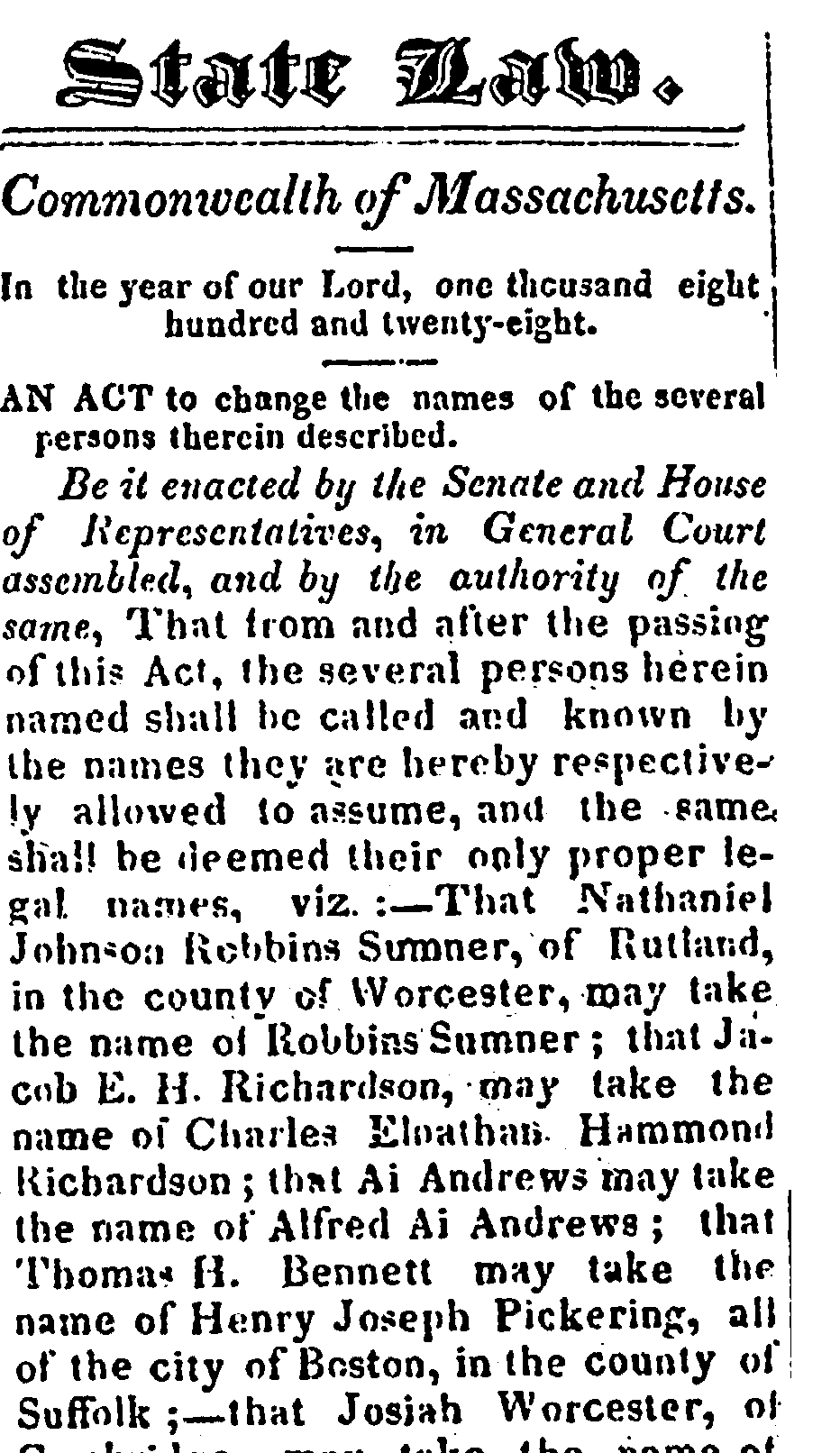
Among the many name changes authorized in 1828 by official Act of the Senate and House of Representatives in the Commonwealth of Massachusetts, it was announced “… that Thomas H. Bennett may take the name of Henry Joseph Pickering,” then residing in “the city of Boston, in the county of Suffolk.”
Taken together, these two pieces of evidence in early 19th century newspaper archives strongly corroborate both the early attribution to “Thomas H. Bennett” and later sources that credit “H. J. Pickering” with authorship of the 1835 reprinting of the same whaling material under the new title, A Concise, Yet Perfect Detail of the Sperm Whale Fishery. This item, as reported by Elizabeth Ingalls in Whaling Prints in the Francis B. Lathrop Collection (Salem, Mass.: Peabody Museum of Salem, 1987) on page 127, was issued as a “promotional pamphlet” for the colored aquatint print of Capturing a Sperm Whale, John Hill’s engraving of the dramatic painting by William Page, from a sketch by the one-armed whaleman Cornelius B. Hulsart.
Happily, the new evidence assembled above fully exonerates Henry J. Pickering from the false charge of plagiarizing the work of “Henry Bradley” in 1835, as alleged by Lefkowicz and Ingalls. Pickering’s authorship of A Voyage from the United States to South America is confirmed by the published announcement of his name change, and the unimpeachable testimony of his former boss Ephraim W. Allen.
Going as “Thomas H. Bennett,” British emigrant Henry J. Pickering was employed by Allen as a compositor for the Newburyport Herald. In Newburyport and later in Boston, young Bennett happily befriended an even younger colleague named William Lloyd Garrison, the future abolitionist and social reformer. Back then Garrison regarded Bennett as an “adventurer and amateur classicist.”4 They briefly reunited in Boston, where Garrison’s earliest and at first his
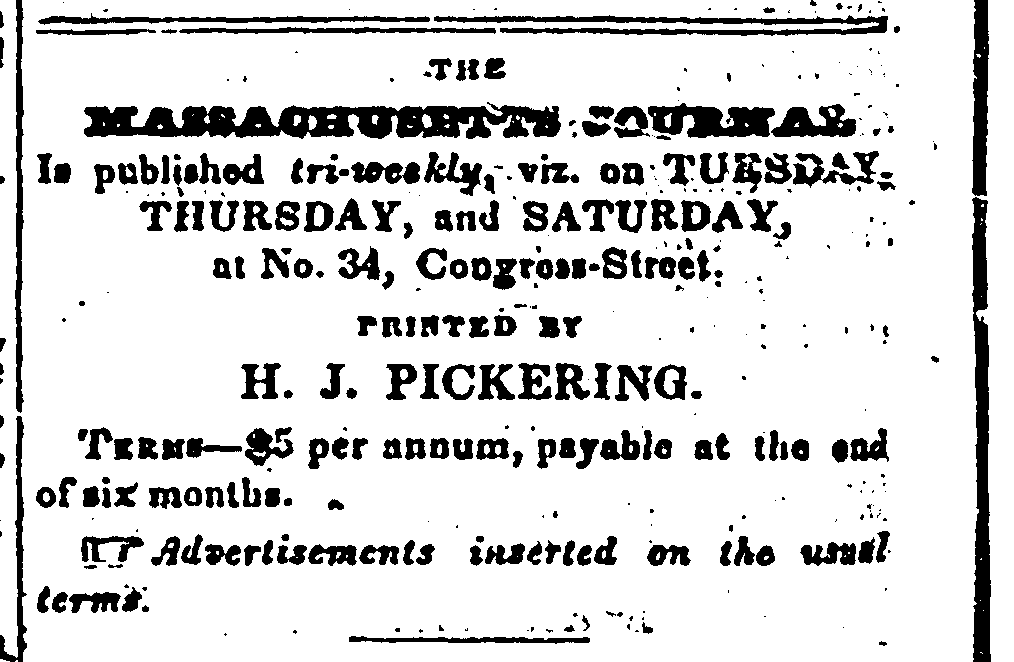
only acquaintance was Mr. Thomas H. Bennett, who had printed at Mr. Allen’s office in Newburyport a translation of Cicero’s “Orations.” Bennett was now printing the Massachusetts Daily Journal, and keeping a boarding-house, where he allowed Garrison to stay whilst he was endeavouring to find work.5
Perhaps Garrison collaborated with his venturesome friend and benefactor at the Massachusetts Journal, for a short while printed by Bennett under his soon-to-be legal name H. J. Pickering.
From 1829 to 1835 Pickering ran the aforementioned Old Countryman in partnership with Edgar W. Davies. On August 12, 1835 a terrible fire at Nassau and Fulton streets in New York City destroyed their printing office along with a great many other businesses and residences.
About his domestic life, I have little information to report at this time, beyond the fact that Henry J. Pickering married Eliza and together the couple had six children. With his family, I would guess, Henry found his way to New Orleans where he became foreman in the printing office of the True American, then edited by John Gibson, newspaperman extraordinaire. I’m sorry to report that Henry J. Pickering died in New Orleans on August 31, 1839, as announced in the New York Public Ledger on September 3, 1839:
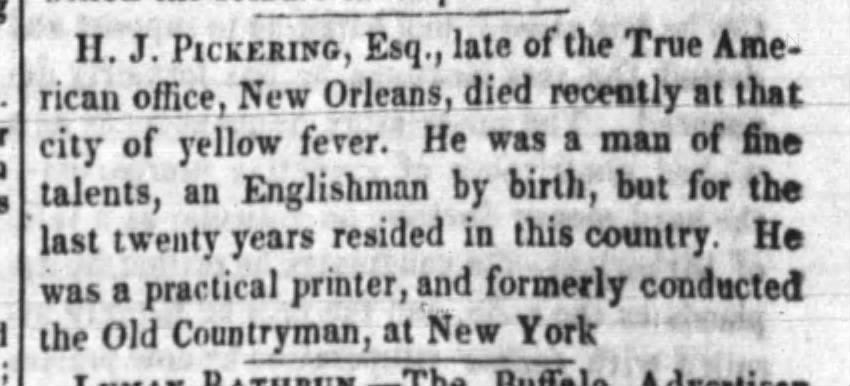
H. J. PICKERING, Esq., late of the True American office, New Orleans, died recently at that city of yellow fever. He was a man of fine talents, an Englishman by birth, but for the last twenty years resided in this country. He was a practical printer, and formerly conducted the Old Countryman, at New York.
A brief but obviously sincere mortuary notice in the True American (September 3, 1839) lamented the “great loss” of their “Foreman” Mr. Pickering, who “united to great ability in his profession, undoubted integrity and the most urbane manners and conciliatory disposition.”
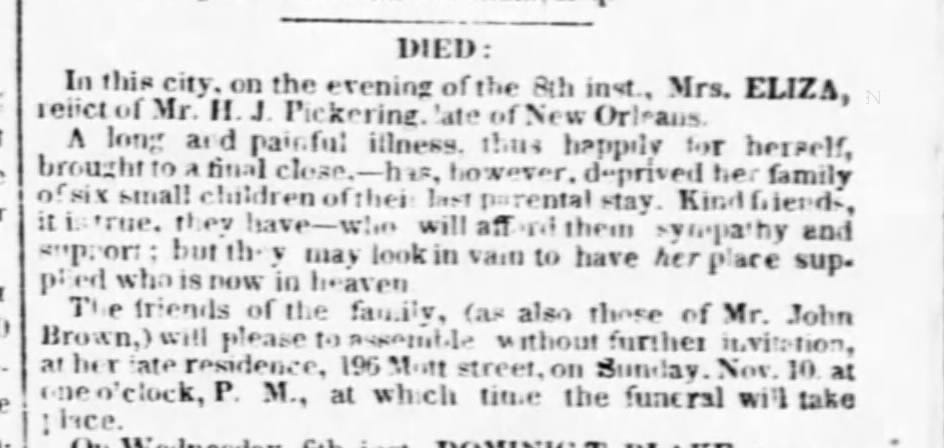
Not long after Henry’s passing his wife Eliza died on November 8, 1839, as reported the next day in the New York Evening Post:
DIED:
In this city, on the evening of the 8th inst., Mrs. ELIZA, relict of Mr. H. J. Pickering, late of New Orleans. A long and painful illness, thus happily for herself, brought to a final close,—has, however, deprived her family of six small children of their last parental stay. Kind friends, it is true, they have—who will afford them sympathy and support; but they may look in vain to have her place supplied who is now in heaven.The friends of the family, (as also those of Mr. John Brown,) will please to assemble without further invitation, at her late residence, 196 Mott street, on Sunday, Nov. 10 at one o-clock, P. M., at which time the funeral will take place.
Six minor children who survived the untimely deaths of both parents were named in a notice of probate that appeared in the Boston Semi-Weekly Advertiser on May 18, 1842. This notice identified one Elijah Spare as legal guardian for these children, all of whom resided in New York City except Ann E. Pickering of Baltimore, Maryland:
Eleanor Pickering
Mary J. Pickering
Caroline L. Pickering
Hannah D. Pickering
John M. Pickering
Ann E. Pickering
Much more in the way of biography and history remains to be discovered, of course. The unfortunate circumstances that ended, too soon, the lives of both Henry J. Pickering and his wife Eliza are awfully sad. It’s good to have some of Henry’s well-received writing for a memorial, with his good name restored as the true author of that “admirably graphic” description of capturing a sperm whale in A Voyage from the United States to South America.
Compiled by Richard H. Shoemaker; see A Checklist of American Imprints for 1823 (Scarecrow Press, 1968), Volume 4, page 24
<https://babel.hathitrust.org/cgi/pt?id=uiug.30112024867936&seq=32>
and 1824 (Scarecrow Press, 1969) Volume 5, page 27
<https://babel.hathitrust.org/cgi/pt?id=mdp.39015079620251&seq=35>
Crediting Boston collector Charles F. Batchelder with initial discovery of the relevant historical evidence, Edward J. Lefkowicz accepted the case for Henry Bradley as the real author of A Voyage from the United States to South America in “Typecase and Ditty Bag: Printers Gone A-Whaling” for the Log of Mystic Seaport Volume 40 Number 4 (Winter 1989) pages 126-136 at 127-130. Conceivably, if “Henry Bradley” and “William Bradley” were indeed more than Ordinary Seamen on the Constellation, their names in the naval log might possibly be explained as early aliases of Henry J. Pickering and his brother the carpenter/mill wright. Chronology would remain a problem, however, for the explanatory value of such a construction. The dates of naval service recorded for Henry Bradley and William Bradley in the Constellation muster and pay rolls do not match the chronology presented in A Voyage from the United States to South America—even adjusting for mistaken dates there (for example two instances of “1821” on pages 59 and 64 where the correct year has to be 1822). Henry Bradley and William Bradley were “paid off at Valparaiso” on February 11, 1821 having served 2 months and 20 days. Their short naval careers began in Rio on November 23, 1820, six months before Henry J. Pickering and his brother “in the month of May, 1821” left Philadelphia “in a brig bound to Rio Janeiro, the capital of the Brazils.” Images of the Constellation muster rolls for 1821 are accessible via fold3.com:
https://www.fold3.com/image/616721463/1821-page-37-us-miscellaneous-records-of-the-navy-department-1776-1930
On the spectacular meteor showers witnessed in the early morning hours of November 13, 1833, see Mark Littmann, The Heavens on Fire: The Great Leonid Meteor Storms (Cambridge University Press, 1998). The “end times” fervor of H. J. Pickering’s editorial on the “Falling Stars” reflected his recent conversion and adoption of a Protestant, evangelical form of Christian worship. Confessing himself to have been “as great a reprobate as the United States could produce” only a few weeks before, Pickering strenuously defended “the truth of the Christian religion” in a public debate at Tammany Hall on Sunday November 24th, sponsored by the radical Society of Moral Philanthropists. Arguments marshaled by H. J. Pickering were reported (and ridiculed) in the New York Free Enquirer on December 1 and 8, 1833. With specific reference to the reception of Mr. Pickering, Albert Post in Popular Freethought in America, 1825-1850 (Columbia University Press, 1943) at page 93 observes:
“It required some hardihood in Christian apologists to appear before the hostile audiences at Tammany Hall; in 1833 Mr. Pickering, editor of the Old Countryman, was roundly hissed for asserting the necessity of an overruling Providence.”
Denis Brennan, The Making of an Abolitionist: William Lloyd Garrison’s Path to Publishing The Liberator (Jefferson, North Carolina: McFarland & Company, Inc., 2014) page 35.
William E. A. Axon, The Story of a Noble Life: William Lloyd Garrison (London: S. W. Partridge & Co., 1890) page 26.