

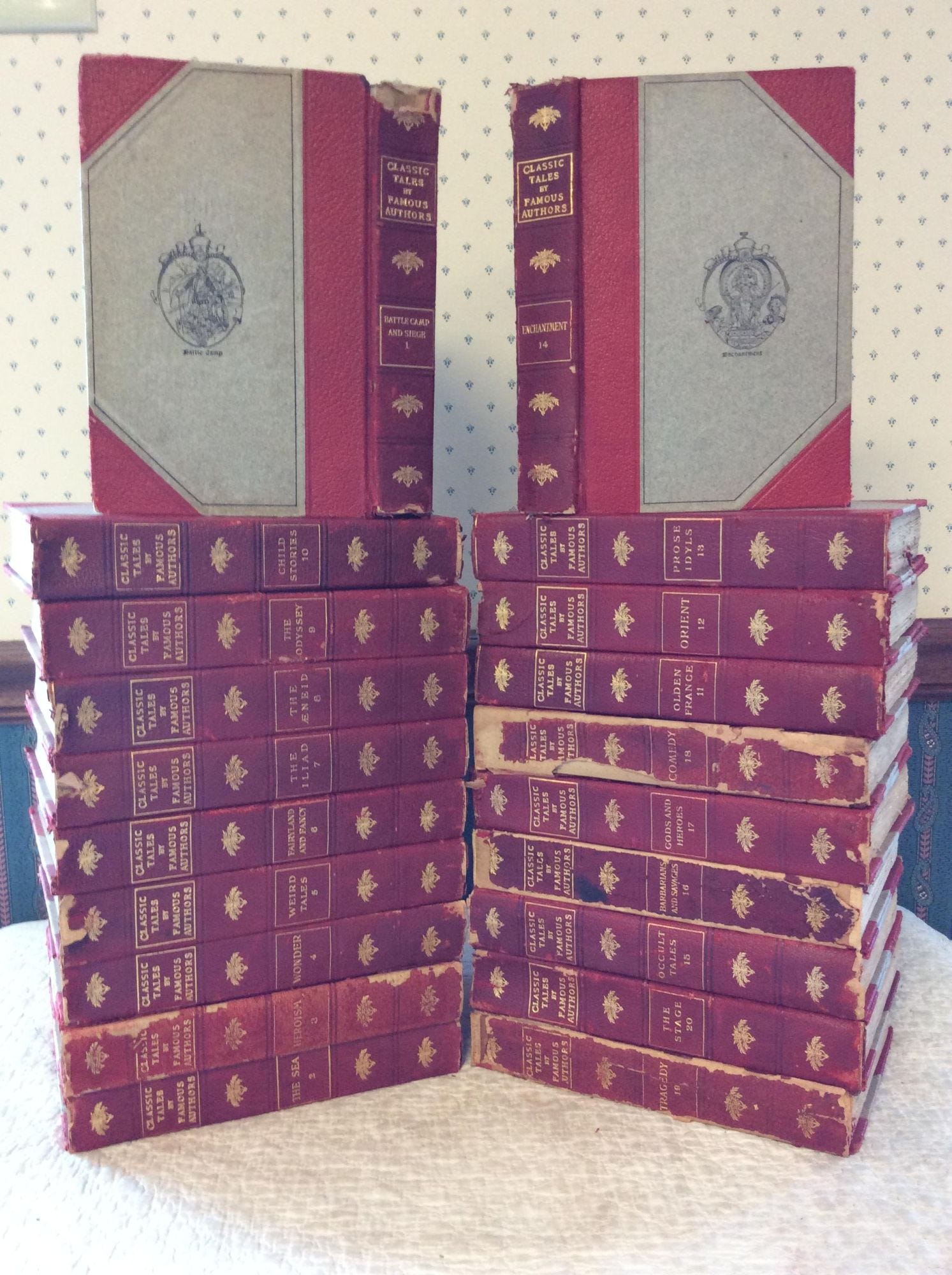
Packed with variously diverting tales of the sea, Volume 2 in the 20-volume Classic Library of Famous Literature (New York: The Bodleian Society, 1902) gives Moby-Dick its due, and then some. This particular volume offers a bold abridgement of Herman Melville’s 1851 masterpiece by series editor-arranger Frederick B. De Berard (1853-1927). The editorially condensed version unfolds in twenty-three sections that draw generously from narrative and Ahab-centered chapters of Moby-Dick, casting them collectively as “The Epic of the Whale.” 1
Six entertaining pieces by other writers follow the reader-friendly digest of Melville’s whaling “Epic.” Hennig Cohen, the outstanding old-school Melville scholar who (way back in the 1970’s) first discovered De Berard’s high regard for Melville and Moby-Dick, thus described the contents of Volume 2 in a little noticed bibliographical note:
Melville is clearly preëminent among a good and varied company. The other selections, in the order in which they appear, are a melodramatic excerpt on Malay pirates from Hard Cash by Charles Reade and Victor Hugo’s bravura description of the cannon that breaks loose on shipboard from Ninety-Three; two personal narratives, Richard Henry Dana on rounding Cape Horn, and an account of “A Real Shipwreck” in the South Seas in the 1870s by the Earl of Pembroke; and finally, two comic selections, William S. Sullivan’s [Gilbert’s] Bab ballad “The Yarn of the Nancy Bell” and Samuel Lover’s Sketch “Barny O’Reirdon, the Navigator.” 2
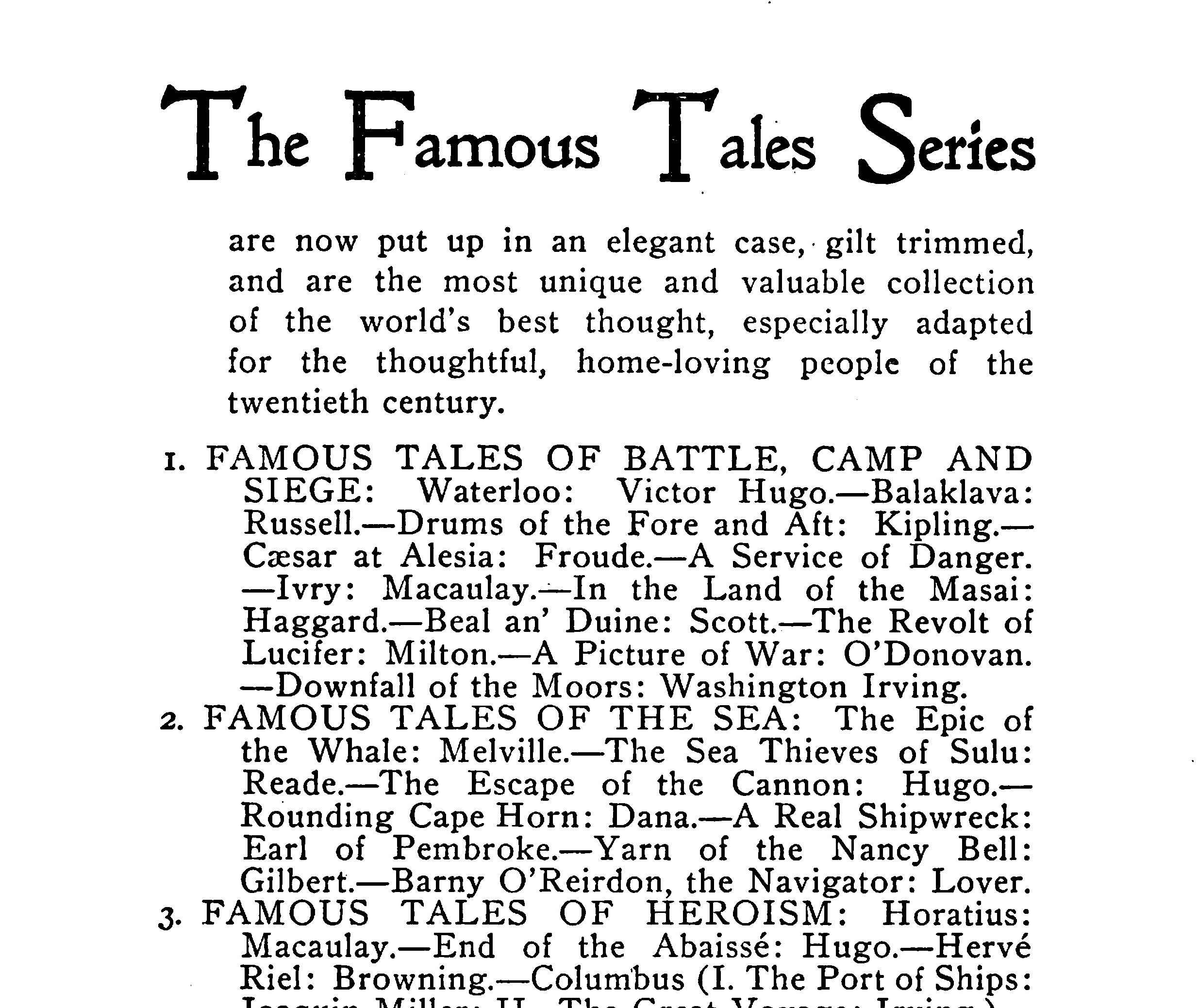
All seven of the nautical stories in Volume 2, including the condensed “Epic of the Whale,” had previously been collected by De Berard in Famous Tales of the Sea (New York: International Book and Publishing Co., 1899; copyrighted by Isaac H. Blanchard Co.).
Below are links to digitized texts of the “The Epic of the Whale” in three differently titled anthologies, each edited by Frederick Brigham De Berard and accessible via either Hathi Trust Digital Library
Epic of the Whale in Famous Tales of the Sea (New York, 1899) pages 11-129.
Epic of the Whale in the Classic Library of Famous Literature (New York, 1902) Volume 2, pages 11-129.
or the Internet Archive:
Epic of the Whale in Classic Tales by Famous Authors (New York, 1905) Volume 2, pages 11-129.
As Cohen also found before me, the 1899 set of Famous Tales lacked the impressive editorial apparatus provided in the 1902 Classic Library and 1905 Classic Tales volumes produced in New York by the Bodleian Society (not affiliated with the renowned library in Oxford, England).
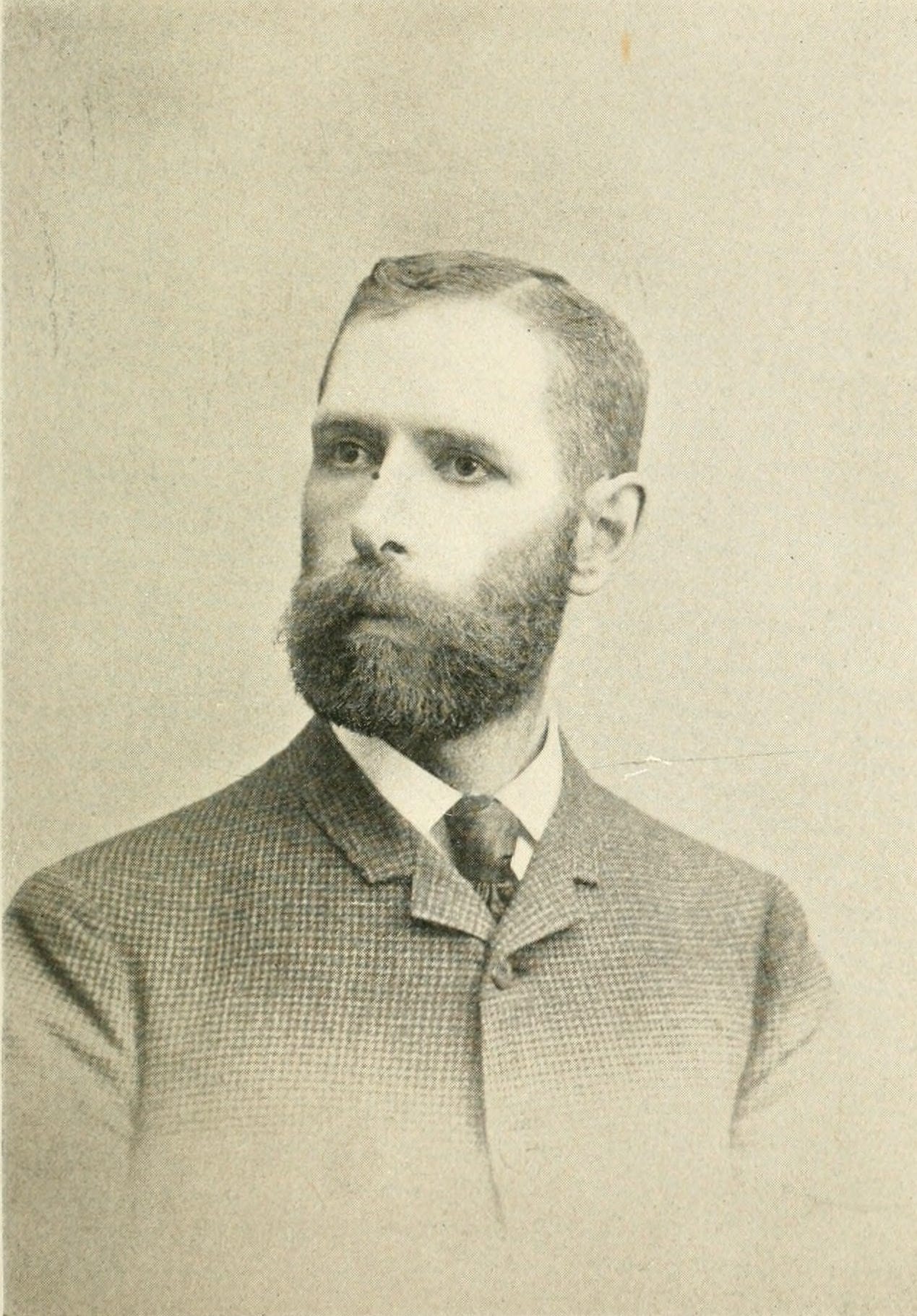
The 1902 and 1905 sets contain the same “General Preface” by Frederick B. De Berard and “General Introduction” by Rossiter Johnson, presented sequentially in the front of Volume 1 (featuring stories of “Battle, Camp and Siege”) together with dignified photographic portraits of De Berard and Johnson. Although Rossiter Johnson had personally known and corresponded with Herman Melville, the “General Introduction” that Johnson provided does not specifically mention or identify the author of Moby-Dick alongside other, named American writers including Irving, Poe, Hawthorne, Edward Everett Hale, and Bret Harte.3 De Berard likewise left Melville out of the “General Preface,” although it opens quoting Sir Thomas Browne (one of Melville’s favorite authors) on mutability (one of Melville’s favorite themes). As a good bibliophile should, De Berard fairly revels in the enjoyment of timeless “literature of imagination and fancy—the powerful imaginings of the great romancers and novelists, the beautiful fancies of great poets.” De Berard’s enthusiasm for books and authors, and for a shared culture of reading based on great works of literature, seems boundless.4 His remarkably ardent “General Preface” begs for a closer look which I hope to give in a future post.
Here I want to focus on Volume 2 of the Classic Library and Classic Tales anthologies, where De Berard more than made up for the seeming neglect of Melville in Volume 1 by supplying a “Critical Synopsis” of the abridged Moby-Dick and short bio of its author.5 Absent from most accounts of the legendary “Melville Revival,” the editorial contributions of Frederick Brigham De Berard deserve I think a wider circulation and appreciation. To that end, complete texts of the relevant “Critical Synopsis” and “Biographical” entry are given below, transcribed from digital images of Volume 2 in Classic Tales by Famous Authors (1905). Texts in Classic Tales are identical with those in the earlier Classic Library of Famous Literature (1902). For example, the typographical error of “Tmbiguities” for “Ambiguities” appears in both editions.
Enjoy!
CRITICAL SYNOPSIS OF SELECTIONS [ pages iii-iv ]
EPIC OF THE WHALE, THE : BY HERMAN MELVILLE
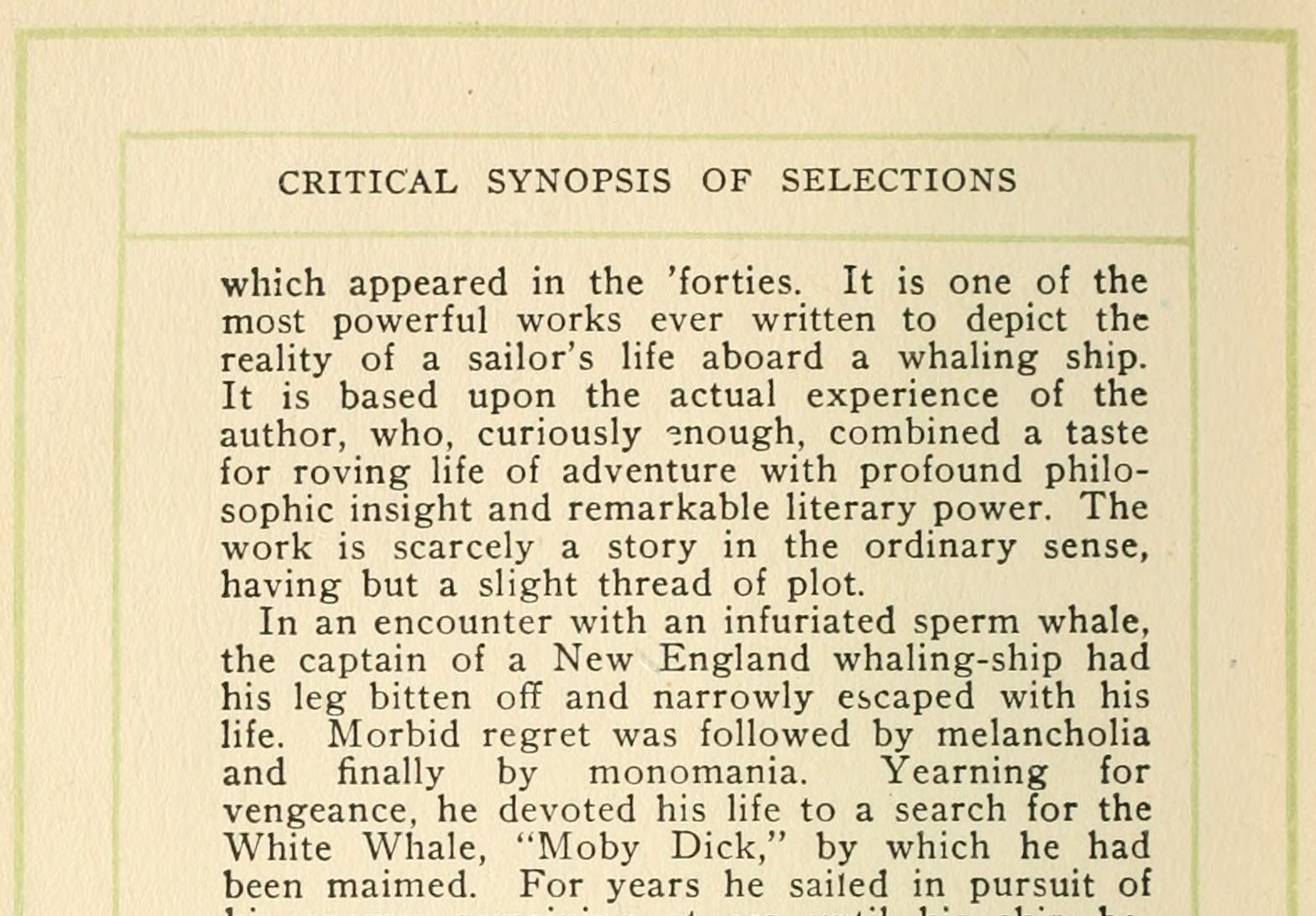
This is an abstract, or condensation, of the famous book, “Moby Dick; or, the White Whale,” which appeared in the ‘forties. It is one of the most powerful works ever written to depict the reality of a sailor’s life aboard a whaling ship. It is based upon the actual experience of the author, who, curiously enough, combined a taste for roving life of adventure with profound philosophic insight and remarkable literary power. The work is scarcely a story in the ordinary sense, having but a slight thread of plot.
In an encounter with an infuriated sperm whale, the captain of a New England whaling-ship had his leg bitten off and narrowly escaped with his life. Morbid regret was followed by melancholia and finally by monomania. Yearning for vengeance, he devoted his life to a search for the White Whale, “Moby Dick,” by which he had been maimed. For years he sailed in pursuit of his enemy, remaining at sea until his ship became crazy and weather-worn, and his crew were inspired with superstitious dread of the half-mythical monster, of whose very existence they were in doubt. The finding of the great whale, the attack upon it, and the destruction wrought upon boats, ship and crew, are related in the story. This slight and fanciful romance is the foundation for a series of intensely graphic descriptions of whaling life, of the sea and the creatures that dwell therein. The episodes descriptive of the whale and his life are classics of natural history. The accounts of the chase and capture of the mighty cetacean are unrivaled for their dramatic force and powerful diction. The present arrangement includes the narrative portions and those episodes relating directly to whale-life and whaling.
BIOGRAPHICAL DICTIONARY OF AUTHORS [ pages x - xi ]
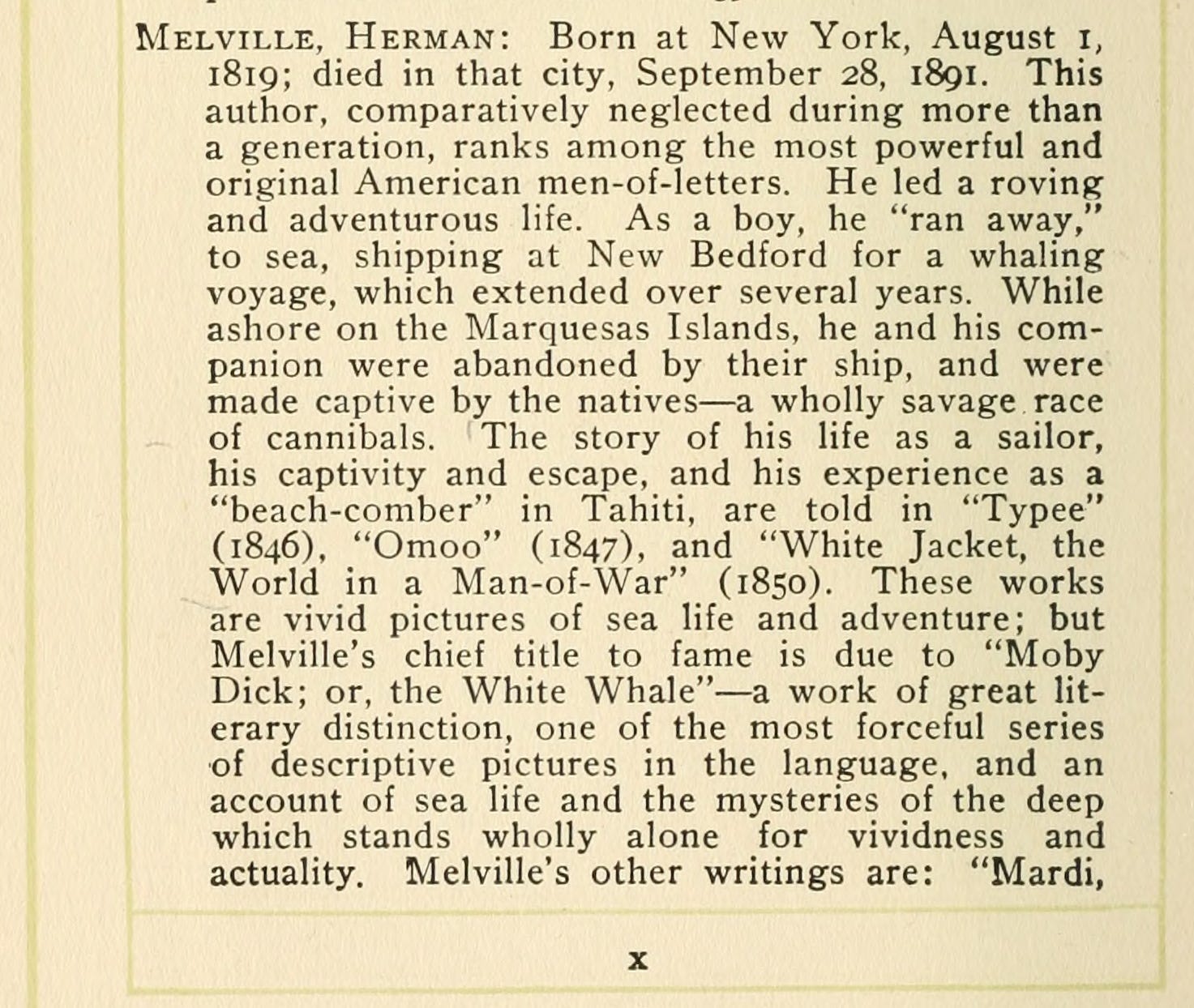
... MELVILLE, HERMAN: Born at New York, August 1, 1819; died in that city, September 28, 1891. This author, comparatively neglected during more than a generation, ranks among the most powerful and original American men-of-letters. He led a roving and adventurous life. As a boy, he “ran away,” to sea, shipping at New Bedford for a whaling voyage, which extended over several years. While ashore on the Marquesas Islands, he and his companion were abandoned by their ship, and were made captive by the natives — a wholly savage race of cannibals. The story of his life as a sailor, his captivity and escape, and his experience as a “beach-comber” in Tahiti, are told in “Typee” (1846), “Omoo” (1847), and “White Jacket, the World in a Man-of-War” (1850). These works are vivid pictures of sea life and adventure; but Melville’s chief title to fame is due to “Moby Dick; or, the White Whale” — a work of great literary distinction, one of the most forceful series of descriptive pictures in the language, and an account of sea life and the mysteries of the deep which stands wholly alone for vividness and actuality. Melville’s other writings are: “Mardi, Etc.’‘ (1849), “Redburn” (1849), “Pierre; or, the Tmbiguities” (1852), several volumes of poems and short stories. He gave public lectures in the years 1857 to 1860; and from 1866 to 1885 was an official in the New York Customs Office. He became morbid in his later years, rigidly secluded himself from the public and all but a few friends, and died a recluse.
Editor Frederick B. De Berard compiled “The Epic of the Whale” from the following chapters in Moby-Dick; or, The Whale (1851), evidently using some version of the oft reprinted 1892 edition titled Moby Dick or the White Whale and copyrighted by Herman’s widow Elizabeth Shaw Melville.
The Monomaniac Captain [Chapter 36, The Quarter-Deck]
Moby Dick [41]
The Chase [Chapter 47, The Mat-Maker; and Chapter 48, The First Lowering]
The Line [60]
Stubb Kills a Whale [61]
The Dart [62]
The Crotch [63]
The Sharks [64, Stubb’s Supper]
Cutting In [67]
The Monkey-Rope [72]
The Sperm Whale’s Head [74]
The Battering-Ram [76]
The Great Heidelburgh Tun [77]
The Pequod Meets the Virgin [81]
Pitchpoling [84]
The Tail [86]
The Grand Armada [87]
The Try Works [96]
Stowing Down and Clearing Up [98]
Measurement of the Whale’s Skeleton [103]
The Chase—First Day [133]
The Chase—Second Day [134]
The Chase—Third Day [135]
Hennig Cohen, “The Famous Tales Anthologies: Recognition of Melville, 1899” in Brodie, Alexander H., et al. “Bibliographical Notes.” The Papers of the Bibliographical Society of America, volume 68, number 2, 1974, pages 63–83. JSTOR, http://www.jstor.org/stable/24302066. Accessed 4 Oct. 2026. In the quoted passage, Cohen incorrectly attributes the “Yarn of Nancy Bell” to “William S. Sullivan,” apparently confusing William S. Gilbert with Gilbert’s composing partner Arthur Sullivan. De Berard’s Famous Tales of the Sea (1899); Classic Library (1902); and Classic Tales (1905) all credit the comic “Yarn” to Gilbert.
Ignored in the Historical Note for the 1988 Northwestern-Newberry Edition of Moby-Dick, Hennig Cohen’s 1974 find is rarely mentioned in subsequent Melville scolarship. Michael Kearns broke the silence by citing Cohen’s discovery as more good evidence for the popular appeal of Moby-Dick before the academic “Melville Revival.” See Michael Kearns, Writing for the Street, Writing in the Garret: Melville, Dickinson, and Private Publication (The Ohio State University Press, 2010) page 127. Accessible via JSTOR, https://doi.org/10.2307/j.ctv16qk3jw.9 and Project MUSE, https://muse.jhu.edu/pub/30/oa_monograph/book/24310/pdf.
For the content of known letters to Rossiter Johnson, see Herman Melville, Correspondence, edited by Lynn Horth (Northwestern University Press, 1993) pages 503-504.
<https://books.google.com/books/about/Correspondence.html?id=nBeBBc3m4yYC>
In the role of author F. B. De Berard contributed two pieces of his own to the Classic Library/Classic Tales anthology. Volume 3 includes De Berard’s"How They Took the Kashmir Bastion" with other “Tales of Heroism”; and Volume 17 places his account of Baldur the Beautiful with "Famous Tales of Gods and Heroes.” Brief as it is, De Berard’s modest author bio in Volume 3 may serve as a helpful starting point for further study:
DE BERARD, FREDERICK B. : Born at Racine, Wis., 1853. A prolific writer during the past twenty-five years, but mainly upon technical subjects and topics of temporary interest. His strictly literary work has been confined to criticisms, reviews and a very few stories and poems. For a number of years he has been occupied with practical studies of economic questions, and particularly with investigations touching taxation and the municipal management of the city of New York.
<https://archive.org/details/classictalesbyfa03debe/page/n33/mode/2up>
Born October 4, 1853, Frederick B. De Berard was a son of Frances Julia Merrill and Fredrick William De Berard, a grocer in Racine, Wisconsin. Frederick B. married Anna Mary Collins (Annie) in Chicago on June 4, 1878 and the couple had two children. During the first three decades of the 20th century, De Berard worked for the Merchants’ Association of New York as a statistician and eventually chief researcher. He died of a sudden heart attack at the age of 73, as reported in the Brooklyn Eagle for August 12, 1927:
Frederick B. DeBerard of 544 E. 18th St., for 30 years connected with the Merchants Association of New York and regarded as one of the ablest investigators in this city, died Wednesday [August 10, 1927] at Lake Parlin, M[ain]e., where he had been spending the summer. Death was due to heart trouble.
Mr. DeBerard, who was 73 years old, had been connected with the Merchants Association since it was founded and at the time of his death was director of research for the organization. He was in charge of all its important investigations. He was born in Racine, Wis., and is survived by his widow, Mrs. Annie M. DeBerard; a daughter, Miss Hazel DeBerard, and a son, Willard E. DeBerard. Services will be held in the Fairchild Chapel, 36 Lefferts pl., tomorrow afternoon at 1 o’clock. Interment will be in Kensico Cemetery.
As previously noted by Cohen, two other volumes in the Classical Library and Classic Tales sets also contain writings by Melville: Volume 14 reprints Melville’s short fiction The Bell Tower as one of six “Famous Tales of Enchantment”; and Volume 16 collects “Famous Tales of Barbarians and Savages” including Captive among Cannibals, condensed from passages in the latter half of Melville’s first book, Typee, more specifically chapters 15-19, 30, 32, and 34. Four stories in Volume 16 headed “In the South Seas” are adapted from two collections by Louis Becke (not Typee as stated in Cohen’s 1974 “Note”). De Berard excerpted “Rangers of the Tia Kau” from Becke’s By Reef and Palm (London; T. Fisher Unwin, 1894); “Ninia,” “At a Kava Drinking,” and “Feast at Pentecost” are from The Ebbing of the Tide: South Sea Stories by Louis Becke (J. B. Lippincott Company, 1896).
You may be excited to know I was a Tour Guide at his home in The Berkshires for several summers. This is where he wrote Moby Dick.
Here is his study and view from his window.